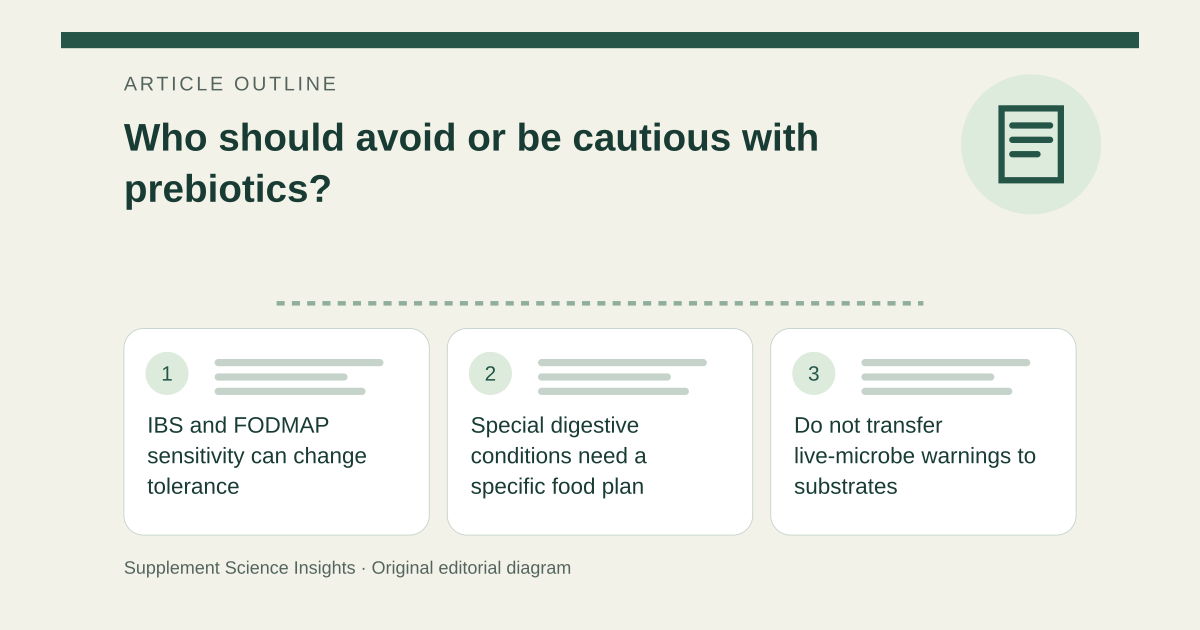
IBS and FODMAP sensitivity can change tolerance
Fructans and GOS can act as prebiotics but also trigger symptoms in susceptible people with IBS. Monash notes that inulin or FOS in synbiotic products may be poorly tolerated. This does not mean all fiber is harmful or that every person with IBS must permanently exclude prebiotic foods. [1][2]
Special digestive conditions need a specific food plan
People with bowel strictures or significant digestive disease should follow individualized nutrition advice. AGA notes that strictures can require changes in food texture. This is a reason to review a concentrated fiber product with the treating team, not to assume a universal prohibition on all prebiotics. [3]
Do not transfer live-microbe warnings to substrates
Prebiotics do not contain living organisms by definition. Warnings about probiotic infections therefore do not automatically apply to a plain prebiotic. A synbiotic contains both, however, and deserves review of each component, particularly during serious illness or immune suppression. [4][5]
Adjust the decision to symptoms and formulation
Imagine an inulin-containing blend repeatedly increases bloating. More is not necessarily better; stop or reduce the optional product and review its role with a dietitian or clinician. An allergy to another ingredient or a medically prescribed diet also matters. Persistent symptoms should not be dismissed as proof that the product is working. [1][4]
| Situation | Action |
|---|---|
| FODMAP-sensitive IBS | Review type and tolerance |
| Stricture or tailored diet | Use clinical nutrition advice |
| Synbiotic blend | Assess live organisms separately |
| Worsening symptoms | Reassess rather than escalate |
Sources for this article
- Treatments for IBS | Monash FODMAP - Monash Fodmap
Source consulted: 2026-09-21. This is a reference resource, not a claim that we conducted the studies or tested a product. - Prebiotics and probiotics - A blog by Monash FODMAP | The experts in diet for IBS - Monash Fodmap
Source consulted: 2026-09-21. This is a reference resource, not a claim that we conducted the studies or tested a product. - diet and nutritional therapies in IBD
Source consulted: 2026-09-21. This is a reference resource, not a claim that we conducted the studies or tested a product. - Prebiotics - International Scientific Association for Probiotics and Prebiotics (ISAPP)
Source consulted: 2026-09-21. This is a reference resource, not a claim that we conducted the studies or tested a product. - Probiotics - Health Professional Fact Sheet
Source consulted: 2026-09-21. This is a reference resource, not a claim that we conducted the studies or tested a product.