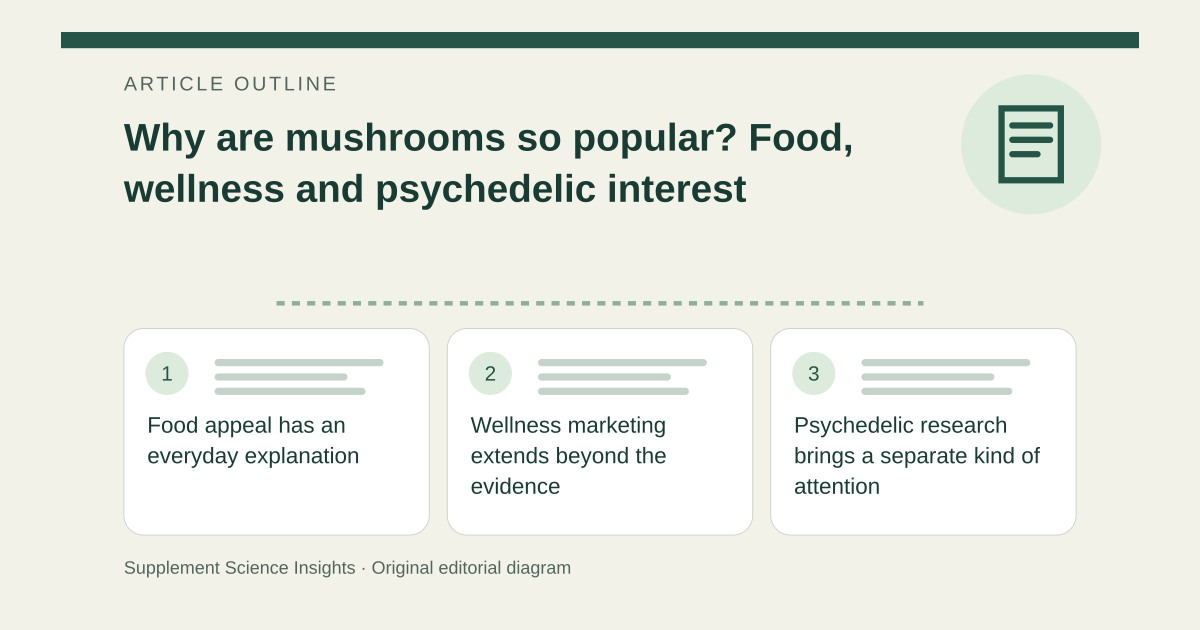
Food appeal has an everyday explanation
Culinary mushrooms offer varied flavors and textures and can fit many recipes. Their usefulness in meals does not depend on claims about memory, immunity or disease prevention. [1]
Wellness marketing extends beyond the evidence
Some extracts are promoted for cognition, stress or mood. For example, MSK describes limited clinical data for lion’s mane alongside substantial preclinical research. That is different from a broadly established benefit for every mushroom blend. [2]
Psychedelic research brings a separate kind of attention
Research into psilocybin for depression, addiction and other conditions has increased public interest. Promising clinical findings do not establish that a shop product, retreat or unsupervised experience reproduces a tested intervention. [3]
Match the claim to the actual category
Imagine a food-mushroom coffee advertisement invokes psychedelic neuroscience. The ingredients may not contain the studied compound at all. Evaluate the specific formulation and outcome instead of borrowing credibility from the wider mushroom trend. [1][3]
| Category | Reason for interest |
|---|---|
| Culinary mushrooms | Taste and texture |
| Functional extracts | Wellness claims with variable evidence |
| Psilocybin research | Possible clinical applications |
| Online popularity | Not proof of benefit |
Sources for this article
- Fruit and Vegetable Guide Series: Mushrooms | USU
Source consulted: 2026-09-21. This is a reference resource, not a claim that we conducted the studies or tested a product. - Lion's Mane Mushroom | Memorial Sloan Kettering Cancer Center
Source consulted: 2026-09-21. This is a reference resource, not a claim that we conducted the studies or tested a product. - Psilocybin for Mental Health and Addiction: What You Need To Know | NCCIH
Source consulted: 2026-09-21. This is a reference resource, not a claim that we conducted the studies or tested a product.