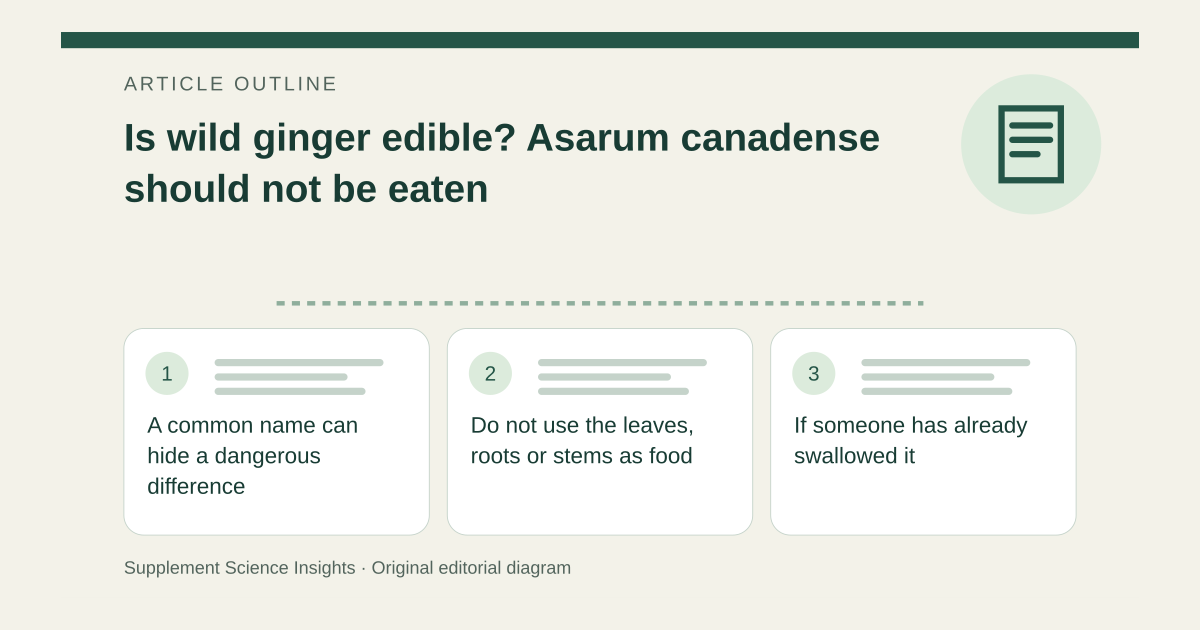
A common name can hide a dangerous difference
Asarum canadense belongs to the Aristolochiaceae family. Its wild-ginger name does not make it a substitute for grocery-store Zingiber officinale. Other plants also have similar common names, so this warning concerns the identified species rather than every plant someone calls wild ginger. [1]
Do not use the leaves, roots or stems as food
NC State Extension identifies aristolochic acid as a kidney-toxic and carcinogenic constituent and advises not consuming any part of Asarum canadense. Historical food or medicinal use is not a reliable safety assurance. Do not taste an unidentified plant to decide whether it resembles ginger. [1]
If someone has already swallowed it
Contact Poison Help in the United States at 1-800-222-1222 for case-specific advice. Do not induce vomiting. Call 911 if the person collapses, has a seizure, has trouble breathing or cannot be awakened. Keep the plant identification or a photograph available, without delaying the call. [2]
Choose the grocery ingredient by identity
Imagine a foraged root smells ginger-like and is offered for tea. Smell and the common name cannot establish edibility. Leave it out of food; use correctly identified culinary ginger for the recipe. [1][3]
| Choice | What to check |
|---|---|
| Asarum canadense | Do not consume any part |
| Unidentified wild plant | Do not taste-test |
| Possible ingestion | Get poison advice promptly |
Sources for this article
- Wild Ginger - Asarum canadense | North Carolina Extension Gardener Plant Toolbox
Source consulted: 2026-09-20. This is a reference resource, not a claim that we conducted the studies or tested a product. - Poison Control: First aid guidelines
Source consulted: 2026-09-20. This is a reference resource, not a claim that we conducted the studies or tested a product. - NParks: Fort Canning Spice Garden Trail
Source consulted: 2026-09-20. This is a reference resource, not a claim that we conducted the studies or tested a product.