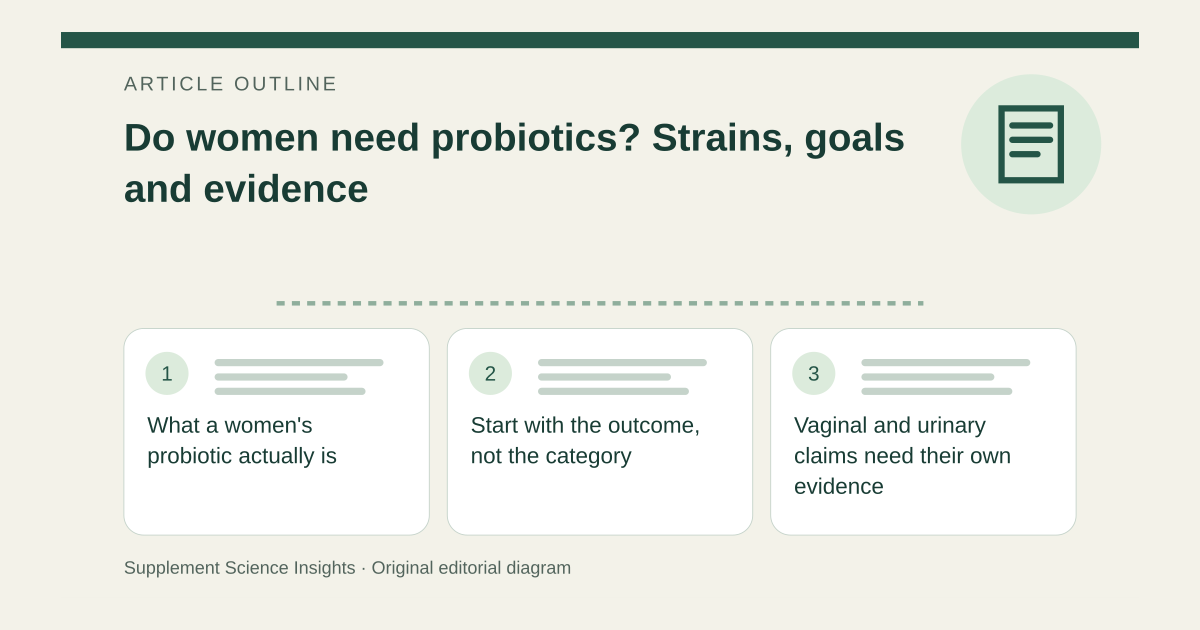
What a women's probiotic actually is
A women's probiotic is generally a product marketed toward women, often with digestive, vaginal or urinary-health claims. The phrase does not identify one standardized mixture of microorganisms. Two products with that description may contain different species, strains and amounts. [1][2]
Probiotics are live microorganisms intended to provide a health benefit. A strain is a more specific identity than a broad bacterial genus. NIH emphasizes that an effect shown for one strain cannot automatically be assigned to another, even when their names look similar. [1][2]
Start with the outcome, not the category
There is no general requirement for all women to take a probiotic. A person considering one should first identify the problem or goal: a particular digestive condition, a treatment-related symptom or another specific outcome. The evidence must then match that goal and the actual preparation. [1][2]
A large colony-forming-unit number or a long strain list is not a substitute for a relevant study. Nor is the presence of bacteria normally found in the body proof that adding them improves an already healthy microbiome. [1][2]
Vaginal and urinary claims need their own evidence
Digestive findings cannot simply be transferred to the vagina or urinary tract. The CDC bacterial-vaginosis guideline excerpt inspected here does not support probiotic products as replacement or adjunctive treatment for BV. NCCIH also describes limited evidence for preventing urinary tract infection, including a review that did not establish benefit. [3][2]
These statements do not mean every future strain or intervention is destined to fail. They mean a generic women's probiotic label is insufficient to justify treating symptoms. Persistent vaginal or urinary symptoms need appropriate assessment rather than assuming that any microbial imbalance has the same cause. [3][2]
Safety and product identity matter
Probiotics have a history of apparently safe use in many healthy people, but detailed safety data are incomplete. NCCIH describes greater risk in people with severe illness or compromised immune systems, including the possibility of infection. A product containing live microorganisms should not be assumed harmless in every clinical setting. [2][1]
Check the strain designation, labeled storage requirements and the evidence for the product's intended use. The distinction between food, a supplement and a clinically studied preparation remains important. A product should not replace effective treatment merely because it is sold without a prescription. [2][1]
A hypothetical evidence comparison
Suppose a study tests a named strain for one digestive outcome, while a bottle advertises vaginal balance and gives only a species name. The population, outcome and strain do not match closely enough to transfer the result. The next step is to find evidence for that exact claim, not to assume that all probiotics work alike. [1]
| Detail | Required comparison |
|---|---|
| Microorganism | Same relevant strain or studied combination |
| Goal | Same clinical outcome |
| Population and route | Relevant users and administration |
Sources for this article
- Probiotics - Health Professional Fact Sheet
Source consulted: 2026-09-20. This is a reference resource, not a claim that we conducted the studies or tested a product. - Probiotics: Usefulness and Safety | NCCIH
Source consulted: 2026-09-20. This is a reference resource, not a claim that we conducted the studies or tested a product. - CDC STI Treatment Guidelines — Bacterial Vaginosis
Source consulted: 2026-09-20. This is a reference resource, not a claim that we conducted the studies or tested a product.