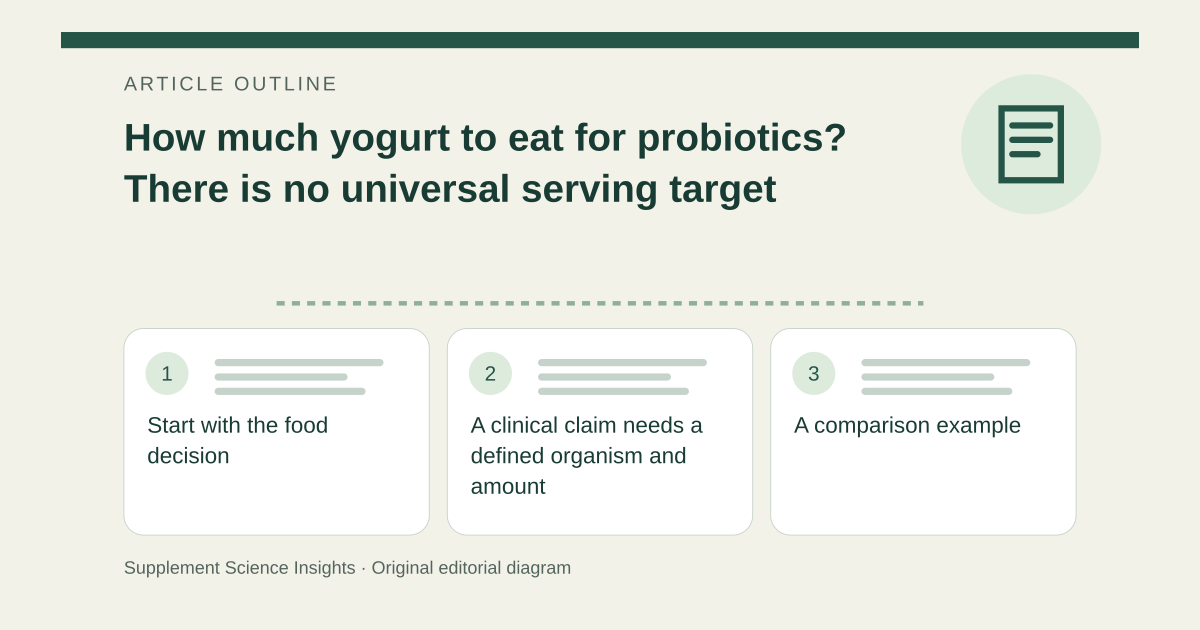
Start with the food decision
Choose a portion that fits the overall diet, preferences and tolerance. A larger tub is not automatically a stronger treatment for digestion. Yogurt’s nutrition and any live-culture properties can both matter, but they should not be collapsed into a single more-is-better rule. [1]
A clinical claim needs a defined organism and amount
If the goal comes from a trial or clinical recommendation, check the exact strain or combination, viable amount and preparation. An ordinary yogurt without that information cannot automatically stand in for the studied intervention. Neither one cup nor several cups is a universal evidence-based probiotic prescription. [2]
A comparison example
Imagine two yogurts have different cultures and one lists a strain-specific count. Equal-sized portions do not necessarily provide the same microbial exposure. Doubling the portion also doubles the rest of the food, which may not fit the dietary purpose. Evaluate the actual label instead of pursuing the largest possible serving. [2]
| Example | Interpretation |
|---|---|
| Food portion | Fits the overall eating pattern |
| Studied probiotic dose | Requires specific preparation data |
| Double portion | Also changes other nutrient intake |
Sources for this article
- The International Scientific Association for Probiotics and Prebiotics (ISAPP) consensus statement on fermented foods | Nature Reviews Gastroenterology & Hepatology
Source consulted: 2026-09-20. This is a reference resource, not a claim that we conducted the studies or tested a product. - Probiotics - Health Professional Fact Sheet
Source consulted: 2026-09-20. This is a reference resource, not a claim that we conducted the studies or tested a product.