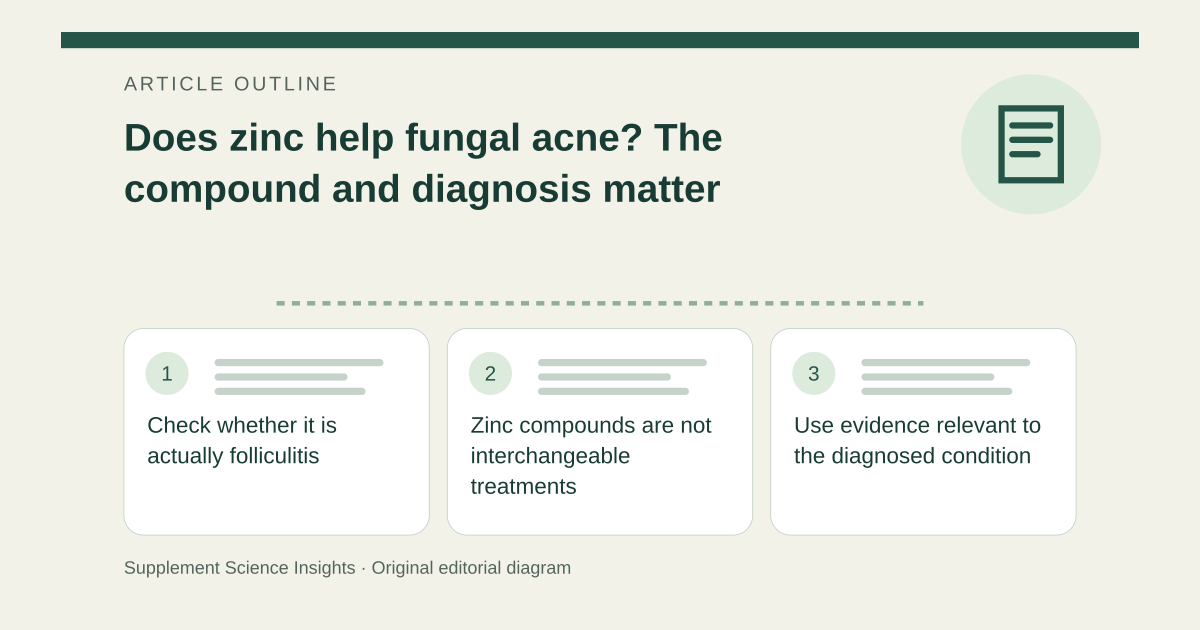
Check whether it is actually folliculitis
DermNet describes Malassezia folliculitis as often itchy, similar-looking bumps or pustules, commonly on the chest or back, without the comedones typical of acne. Other conditions can resemble it, and assessment may include skin sampling. Do not diagnose every breakout from an online photograph. [1]
Zinc compounds are not interchangeable treatments
A zinc-pyrithione soap can be labeled for dandruff and seborrheic dermatitis, while zinc oxide ointment can be a barrier product. Neither label means that oral zinc treats yeast in hair follicles. Match the exact compound, formulation and indication. [2][3][4]
Use evidence relevant to the diagnosed condition
DermNet lists topical antifungal approaches such as ketoconazole, econazole or selenium sulfide and sometimes oral treatment. Selection depends on the case and recurrence. The inspected guidance does not supply a universal zinc-supplement dose or justify replacing prescribed antifungal care with a cosmetic. [1]
Avoid adding irritation to an uncertain diagnosis
Follow the actual product directions and stop if it worsens the skin. A rinse-off medicated wash is not automatically suitable as an overnight mask. Persistent or extensive symptoms should be reviewed rather than treated with progressively stronger home mixtures. [2]
Assess the response to the right treatment
Imagine an anti-dandruff product helps scalp scaling but chest bumps remain. That does not establish resistance to all zinc or confirm the diagnosis. Review the body-site problem and contributing factors separately. [1][5]
| Question | Required distinction |
|---|---|
| What is the diagnosis? | Folliculitis versus acne or another rash |
| Which zinc compound? | Pyrithione, oxide and nutritional salts differ |
| Which body site and route? | Label use is formulation-specific |
| No improvement? | Reassess rather than escalate blindly |
Sources for this article
- Malassezia (pityrosporum) folliculitis
Source consulted: 2026-09-21. This is a reference resource, not a claim that we conducted the studies or tested a product. - DailyMed - ZINC THERAPY- pyrithione zinc soap
Source consulted: 2026-09-21. This is a reference resource, not a claim that we conducted the studies or tested a product. - DailyMed - DIAPER RASH- zinc oxide ointment
Source consulted: 2026-09-21. This is a reference resource, not a claim that we conducted the studies or tested a product. - Zinc - Health Professional Fact Sheet
Source consulted: 2026-09-21. This is a reference resource, not a claim that we conducted the studies or tested a product. - Seborrheic dermatitis: Causes and treatment — DermNet
Source consulted: 2026-09-21. This is a reference resource, not a claim that we conducted the studies or tested a product.