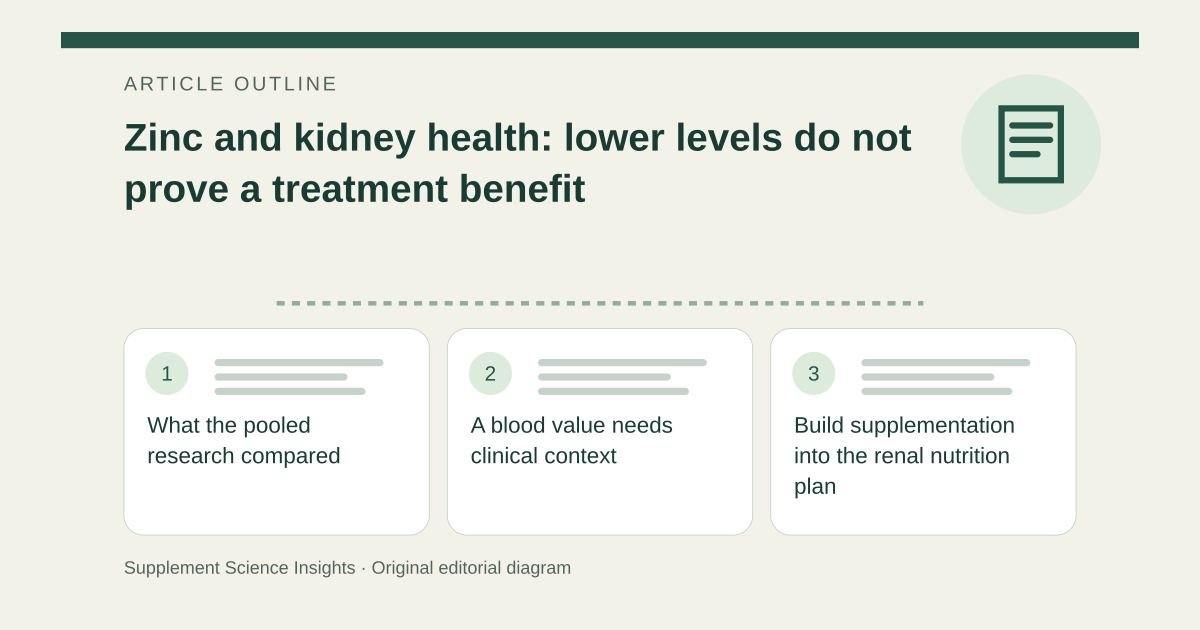
What the pooled research compared
A systematic review published online in 2022 compared serum zinc in chronic kidney disease, hemodialysis and healthy-control groups. Across 42 studies, the kidney-disease groups had lower levels on average. This was an analysis of zinc status, not proof that giving zinc slows kidney failure or improves survival. [1]
A blood value needs clinical context
The review discusses dietary restriction, appetite and dialysis as relevant influences. NIH also describes limitations of serum or plasma zinc as a status measure. A single result should be interpreted with the clinical picture rather than turned directly into a high-dose regimen. [1][2]
Build supplementation into the renal nutrition plan
NKF advises tailoring food and supplement choices to kidney disease and treatment. A kidney dietitian can help reconcile nutrient adequacy with other dietary requirements. A product marketed for kidney support is not proof that its ingredients or amounts fit a particular patient. [3]
Excess zinc creates a different problem
NIH reports that substantial zinc supplementation over time can impair copper absorption and cause adverse effects. The adult upper limit is 40 mg daily from total intake for healthy people; it is not a kidney-treatment dose or a substitute for supervision when higher amounts are prescribed. [2]
Separate deficiency correction from kidney repair
Imagine a dialysis patient has poor intake and a low zinc result. The team may investigate or treat that nutritional problem, but a change in zinc level cannot by itself demonstrate improved filtration or reversal of kidney disease. Follow the outcomes relevant to the actual treatment goal. [1][3]
| Finding | Next distinction |
|---|---|
| Low blood zinc | Assess context and nutritional status |
| Supplement considered | Review renal plan and full label |
| Zinc level rises | Does not alone prove kidney benefit |
| Long-term high intake | Consider copper-related harm |
Sources for this article
- Serum Zinc Levels in Chronic Kidney Disease Patients, Hemodialysis Patients, and Healthy Controls: Systematic Review and Meta-Analysis.
Source consulted: 2026-09-21. This is a reference resource, not a claim that we conducted the studies or tested a product. - Zinc - Health Professional Fact Sheet
Source consulted: 2026-09-21. This is a reference resource, not a claim that we conducted the studies or tested a product. - Nutrition and Kidney Disease, Stages 1-5 (Not on Dialysis) | National Kidney Foundation
Source consulted: 2026-09-21. This is a reference resource, not a claim that we conducted the studies or tested a product.