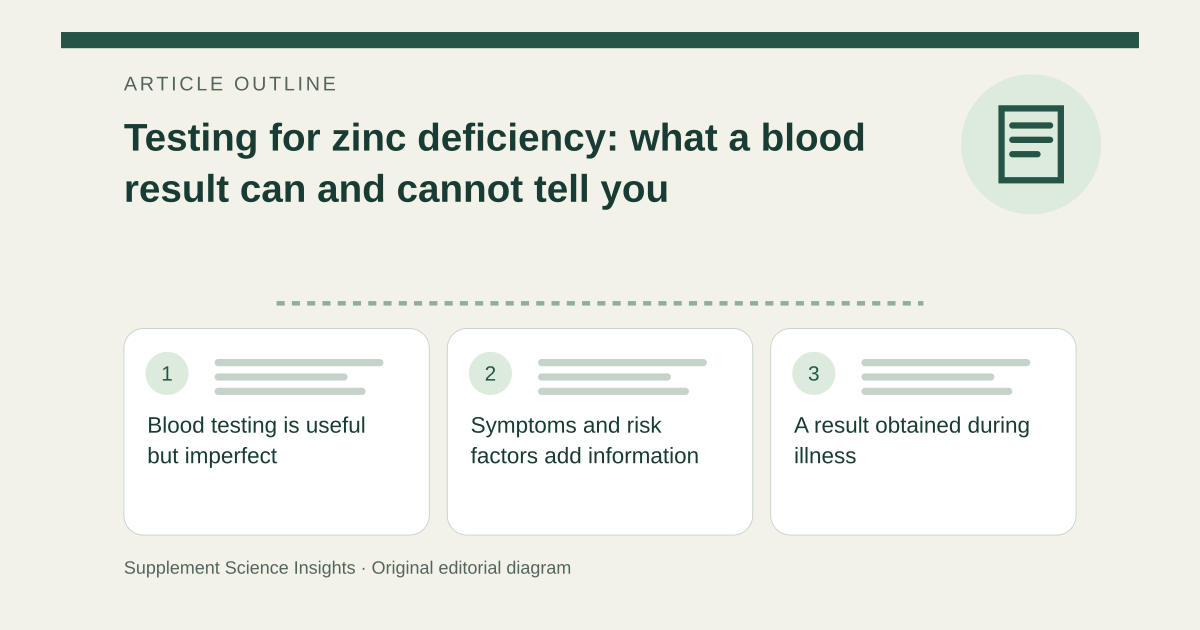
Blood testing is useful but imperfect
Clinicians commonly use serum or plasma zinc concentrations when assessing zinc status. ODS emphasizes important limitations: results vary with age, sex and the time of the blood draw, and they do not always correlate with how much zinc a person consumes. [1]
Infection, changes in steroid hormones and muscle breakdown during illness or weight loss can also affect the concentration. A result outside a reference interval therefore needs interpretation rather than an automatic high-dose response. Use the laboratory units and reference information supplied with the actual result. [1]
Symptoms and risk factors add information
Zinc deficiency can affect taste or smell, wound healing and several other functions. In children, impaired growth, diarrhea or hair loss can occur. These findings are not specific enough to identify zinc deficiency on their own. [1]
The assessment also considers food intake, malabsorptive digestive disease, gastrointestinal surgery and other relevant risks. A person with both compatible symptoms and a known absorption problem presents a different question from someone seeking a screening test without symptoms. [1]
A result obtained during illness
Imagine a person has a low zinc result during an infection and assumes that their usual meals must be deficient. Illness is one possible influence on the measurement, so the result alone cannot reconstruct the diet or identify the mechanism.
A clinician can review when the sample was taken, the symptoms and the intake history before deciding what follow-up is appropriate. This scenario is not a rule that every low result should be ignored or simply repeated.
| Question | What it establishes |
|---|---|
| When was it taken? | Time and illness can influence the value |
| What symptoms and risks exist? | They supply clinical context |
| What zinc products are used? | They clarify exposure, not diagnosis |
Bring the context that makes testing interpretable
Record the exact result and units, recent illness, relevant digestive history and all zinc-containing products. A list that omits a multivitamin or frequent cold lozenges can give an incomplete picture of exposure. [1]
This page does not supply a universal diagnostic cutoff or recommend a screening interval. The ODS summary supports combining laboratory and clinical information; it does not establish that a single test proves either adequate intake or the need for long-term supplementation. [1]
Sources for this article
- NIH ODS — Zinc: Health Professional Fact Sheet
Source consulted: 2026-09-17. This is a reference resource, not a claim that we conducted the studies or tested a product.