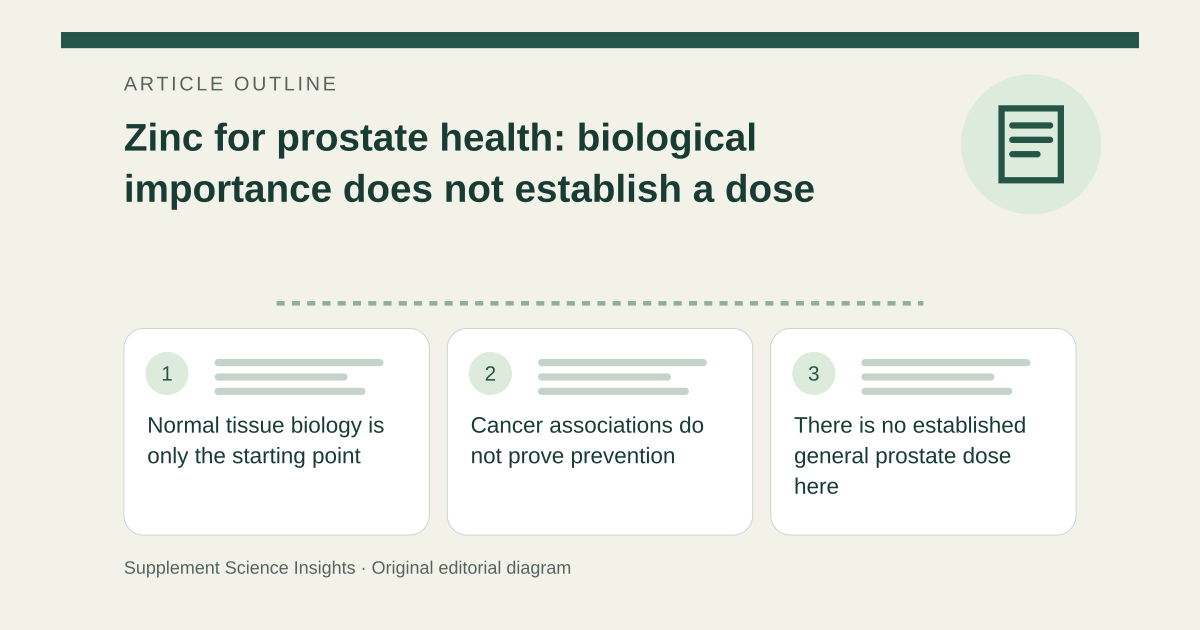
Normal tissue biology is only the starting point
A 2026 review describes zinc involvement in prostate metabolism and secretory function while noting controversy about supplement efficacy and safety. A nutrient concentration in healthy tissue is not itself a prescription or evidence that adding more reverses disease. [1]
Cancer associations do not prove prevention
A 2024 systematic review found lower zinc levels in several measured compartments among people with prostate cancer, but no significant difference in zinc intake. Its included studies were observational. Disease-related changes and other differences between groups limit any inference that zinc pills prevent or treat cancer. [2]
There is no established general prostate dose here
The inspected evidence does not establish one zinc dose across prostate disorders. NIH lists 11 mg daily as the adult male nutritional requirement and 40 mg daily as the adult upper limit from total intake. Neither number is a prostate-treatment prescription; prolonged high supplemental intake can impair copper absorption. [3][1]
Different prostate problems need different care
NIDDK distinguishes inflammation or infection, benign enlargement and cancer. Treatment depends on the condition. Blood in urine, pain or troublesome urinary symptoms should be assessed; inability to urinate requires immediate medical help. A supplement should not delay this evaluation. [4]
Keep the outcome relevant
Imagine a supplement raises blood zinc while urinary obstruction continues. Correcting a nutritional measure would not prove that prostate size or the obstruction improved. Discuss the actual symptoms, diagnosis and treatment goal with the clinician. [4][2]
| Claim | Evidence needed |
|---|---|
| Normal prostate contains zinc | Established physiology |
| Supplement shrinks BPH | Clinical symptom and size outcomes |
| Supplement prevents cancer | Prevention evidence, not tissue association |
| Specific daily dose | Condition-specific benefit and safety |
Sources for this article
- Deciphering the role of zinc in prostate health: From mechanism to therapeutic application.
Source consulted: 2026-09-21. This is a reference resource, not a claim that we conducted the studies or tested a product. - The association between zinc and prostate cancer development: A systematic review and meta-analysis.
Source consulted: 2026-09-21. This is a reference resource, not a claim that we conducted the studies or tested a product. - Zinc - Health Professional Fact Sheet
Source consulted: 2026-09-21. This is a reference resource, not a claim that we conducted the studies or tested a product. - Prostate Problems - NIDDK
Source consulted: 2026-09-21. This is a reference resource, not a claim that we conducted the studies or tested a product.