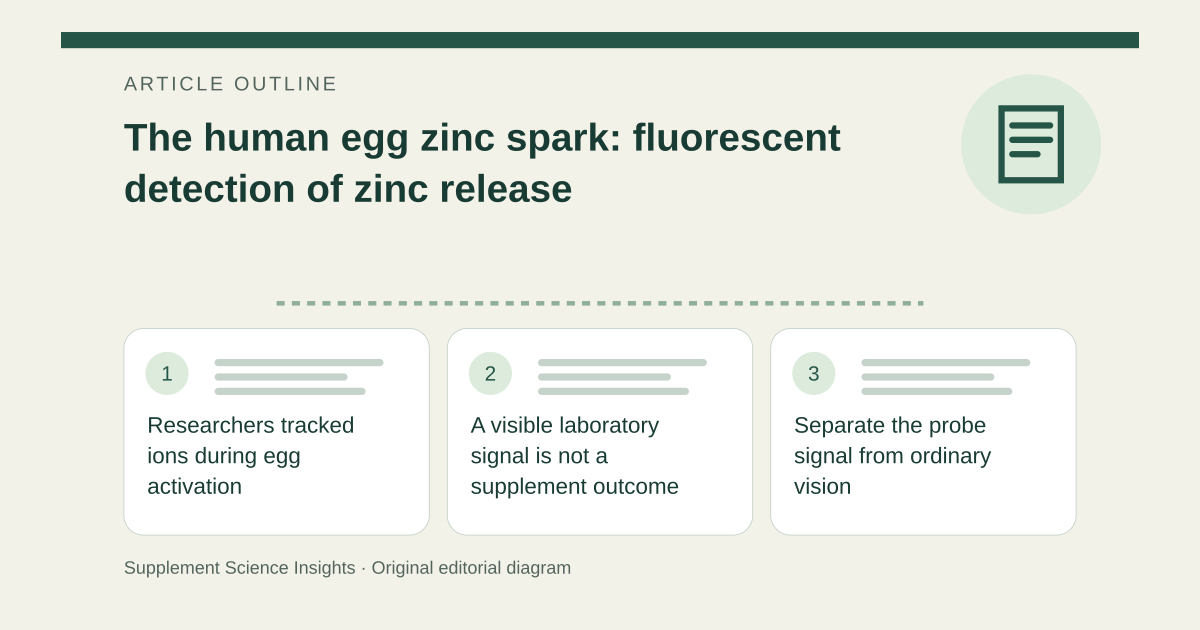
Researchers tracked ions during egg activation
The study used selective fluorescent probes to monitor calcium and zinc in individual human eggs. Several laboratory activation methods triggered a rise in intracellular calcium alongside zinc release into the surrounding space. [1]
The ability to produce this response depended on the egg’s meiotic stage. Researchers also found that experimentally binding intracellular zinc could induce cell-cycle progression. [1]
A visible laboratory signal is not a supplement outcome
The fluorescence method makes an ion-related event detectable; it should not be confused with an unaided-eye flash from an egg. Nor did the study establish a dietary zinc dose, improved pregnancy rates or a validated home fertility test. [1]
The project reported an unrestricted grant from Ferring Pharmaceuticals. Human sample and replicate counts were not established from the abstract. The work helps explain cellular activation, but manipulating ions in an experiment is not equivalent to changing nutrient intake in a person. [1]
Separate the probe signal from ordinary vision
Imagine a fluorescent indicator becomes brighter when it encounters a released ion. The image shows the indicator’s response under the imaging setup, not necessarily light the specimen would visibly emit without the probe.
| Detail | Interpretation |
|---|---|
| Fluorescent probes | Measurement method |
| Zinc release | Observed cellular event |
| Supplement fertility benefit | Not tested |
Sources for this article
- The zinc spark is an inorganic signature of human egg activation - PubMed
Source consulted: 2026-09-19. This is a reference resource, not a claim that we conducted the studies or tested a product.