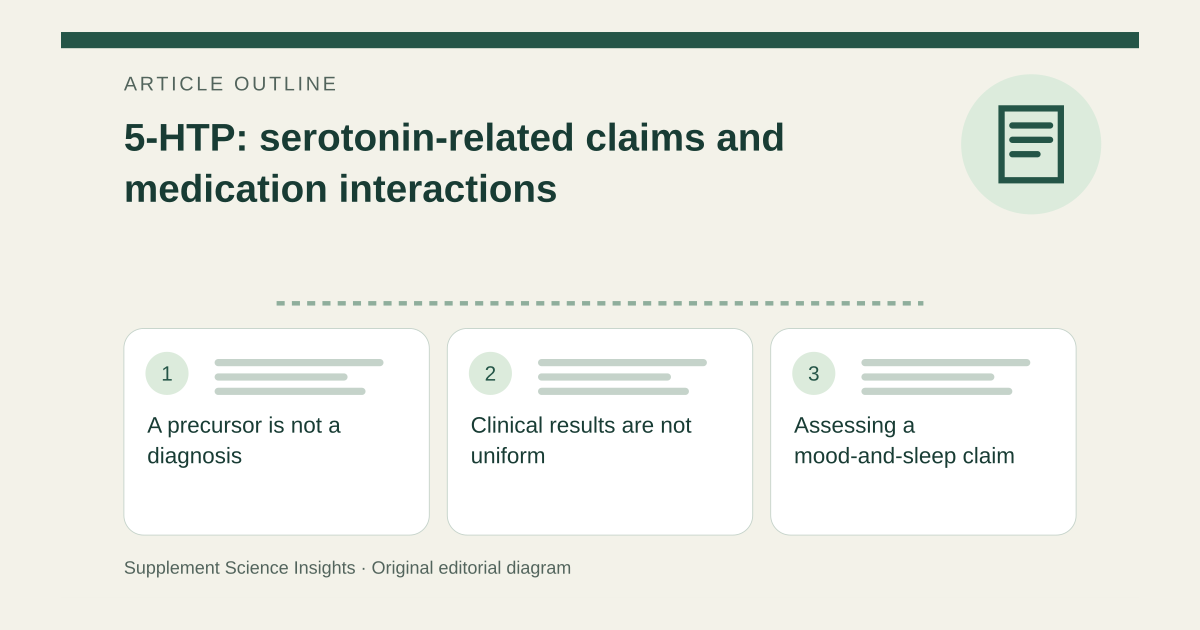
A precursor is not a diagnosis
5-hydroxytryptophan is an intermediate in the production of serotonin and melatonin from tryptophan. MSK notes that supplement ingredients often come from Griffonia simplicifolia seeds. Knowing this pathway does not show why an individual has low mood or poor sleep. [1]
Clinical results are not uniform
MSK describes mostly small studies with mixed findings for mood-related uses. Evidence is insufficient to identify a reliably effective population or treatment approach. A mechanism involving serotonin cannot substitute for a controlled study of the outcome a person actually wants to improve. [1]
Assessing a mood-and-sleep claim
Imagine a bottle makes two promises: better sleep and a more positive mood. A study measuring only a mood questionnaire cannot validate the sleep promise as well. Write down each advertised outcome separately, then look for a study that measures it directly. Avoid counting several claims as several pieces of evidence.
| What a reader sees | What it actually supports |
|---|---|
| Mood questionnaire outcome | Does not automatically establish a sleep benefit |
| Two serotonin-affecting products | Requires an interaction assessment, not a stronger-is-better assumption |
Serotonin-related interactions matter
MSK warns against unsupervised combination with SSRIs, MAOIs, tricyclic antidepressants or other serotonergic drugs because of serotonin syndrome risk. St John’s wort and SAM-e also require caution. Nausea, vomiting and diarrhea occur; 5-HTP can also distort a 5-HIAA urine test. Tell the treating team before taking it or undergoing testing. [1]
What a useful conversation includes
Discuss the symptom, its duration, current treatment and the exact proposed supplement. A commercial name or the word “natural” does not resolve an interaction question. Do not use a supplement decision as a reason to discontinue prescribed treatment. No product or dose is selected in this overview.
Sources for this article
- Memorial Sloan Kettering Cancer Center — 5-HTP
Source consulted: 2026-09-17. This is a reference resource, not a claim that we conducted the studies or tested a product.