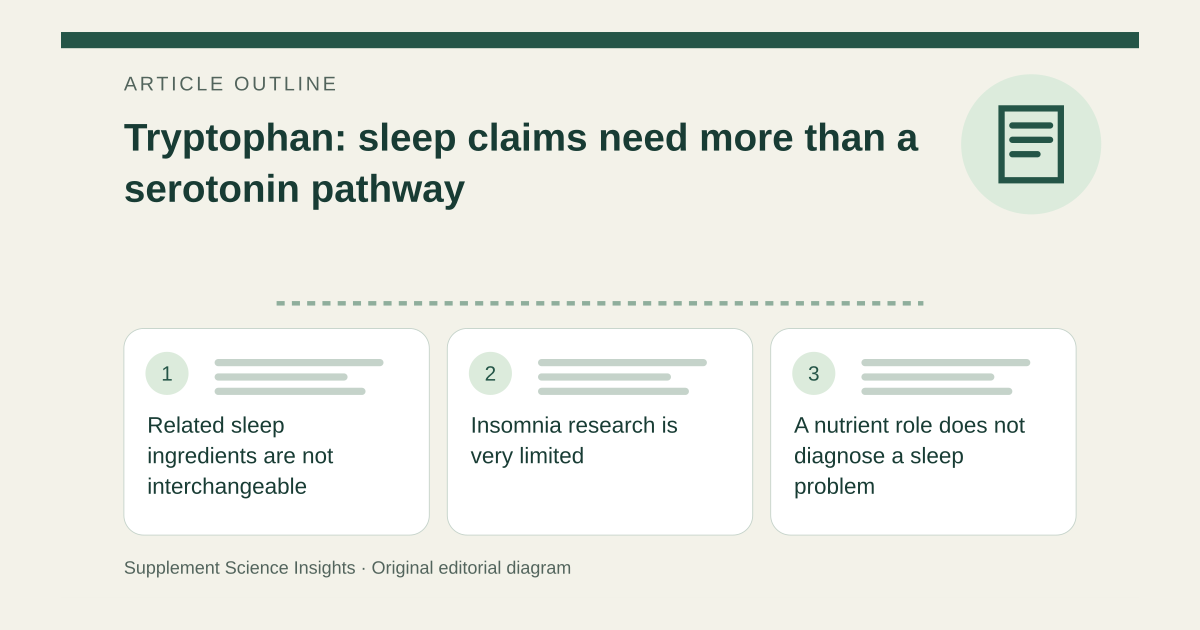
Related sleep ingredients are not interchangeable
L-tryptophan is an amino acid involved in pathways that can lead to serotonin and melatonin. It is different from 5-hydroxytryptophan, often abbreviated 5-HTP, and from melatonin itself. A product should identify which substance it actually contains. [1]
A pathway diagram describes biochemical relationships, not equivalent doses or clinical effects. Supplying an earlier precursor does not establish that a predictable amount of a later compound reaches a particular tissue or produces a desired sleep outcome. [1]
Insomnia research is very limited
NCCIH describes sedative effects but very limited data on insomnia outcomes for tryptophan-related supplements. Its summary notes that the cited American Academy of Sleep Medicine guideline recommended against tryptophan for chronic insomnia. [1]
A person feeling sleepy is not the same as demonstrating improved sleep continuity, restoration or next-day function. A claim should identify the actual endpoint and preparation rather than relying on serotonin-related language as if it were clinical evidence. [1]
A nutrient role does not diagnose a sleep problem
Difficulty sleeping can have different causes, and the existence of a biochemical precursor does not establish that low precursor availability explains a particular person's symptoms. A supplement label cannot diagnose that mechanism.
When reading a study, look for the participants' sleep problem, the comparison, the duration and the other treatments allowed. A study of occasional sleep difficulty cannot automatically answer chronic insomnia, and a combination product cannot isolate tryptophan's contribution. These distinctions help prevent a familiar pathway from becoming an overly broad treatment promise.
Serotonin-related interactions can be serious
Tryptophan supplements can cause potentially life-threatening serotonin toxicity when combined with medicines that affect serotonin metabolism. The complete medication and supplement list needs professional review. This page does not provide a method of combining serotonin-related products or adjusting prescribed treatment. [1]
NCCIH also discusses the historical eosinophilia-myalgia syndrome outbreak linked to contaminated synthetic tryptophan from one manufacturer. That history illustrates a product-quality problem; it should not be rewritten as proof that ordinary food tryptophan caused the outbreak or that every current product is contaminated. [1]
Do not invent a pathway conversion
Imagine a fictional label lists 500 mg tryptophan and another lists 5 mg melatonin. The 100-to-one ratio of printed masses is not a conversion factor between their effects. They are different substances with different handling in the body.
An accurate comparison records the identity and intended use separately. The example does not identify equivalent servings or recommend either product.
| Fictional label | Comparison limit |
|---|---|
| 500 mg tryptophan | Precursor amount |
| 5 mg melatonin | Different compound |
| 100:1 printed mass ratio | Not an effect conversion |
Evaluate the clinical evidence alongside the interaction risk
This overview does not recommend tryptophan for chronic insomnia or mood treatment. A biochemical relationship is useful background, but it cannot replace a well-defined clinical outcome or a careful medication assessment. Keep food intake, concentrated supplements and distinct pathway ingredients separate.
Sources for this article
- NCCIH — Sleep disorders and complementary health approaches
Source consulted: 2026-09-17. This is a reference resource, not a claim that we conducted the studies or tested a product.