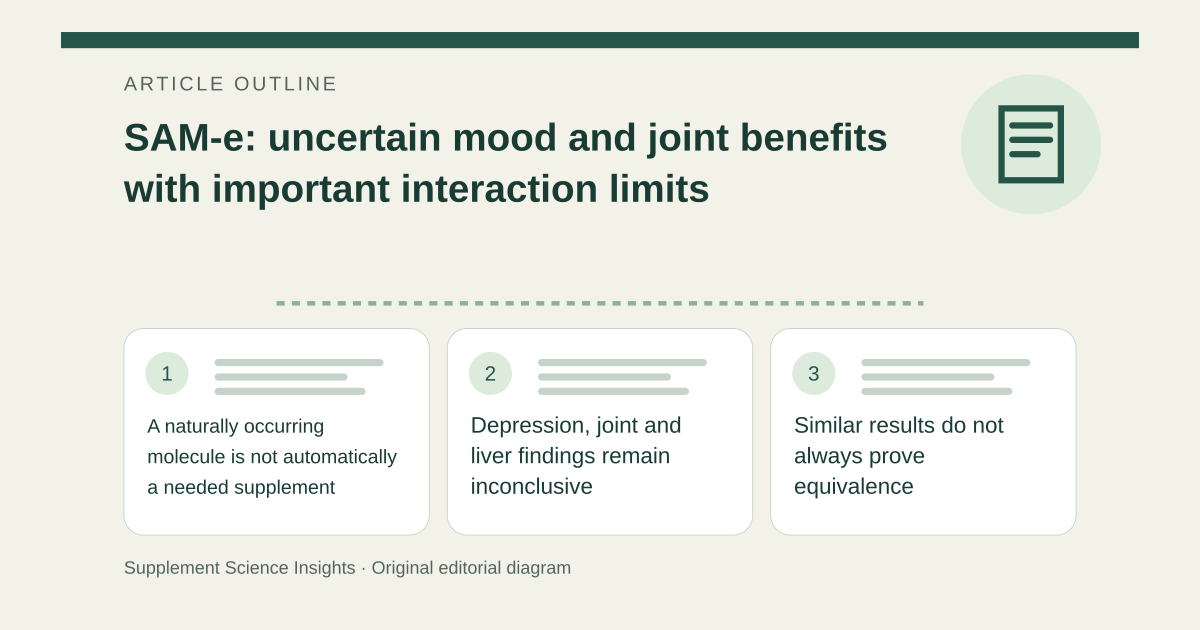
A naturally occurring molecule is not automatically a needed supplement
S-adenosyl-L-methionine, commonly written SAM-e or SAMe, is made in the body from methionine and participates in cellular processes. Its presence in normal biology explains research interest but does not establish a need for extra intake. [1]
Research has used both oral and injected preparations. Those routes should remain separate in a summary because a finding with one does not automatically describe the other. The exact preparation and treatment setting are part of the intervention. [1]
Depression, joint and liver findings remain inconclusive
NCCIH finds that research has not conclusively established benefit for depression, osteoarthritis or liver disease. Many depression studies were small, short or methodologically limited, and some used injections rather than oral supplements. [1]
Joint studies have also been mixed. Comparisons with anti-inflammatory medicines sometimes appeared favorable, while placebo-controlled findings were not consistently positive. Those differences should be reported rather than selecting only the comparison that best supports a product claim. [1]
Similar results do not always prove equivalence
If a small trial finds no statistically clear difference between two treatments, that does not automatically establish that they work equally well. The study may lack enough precision to distinguish them. A credible equivalence or noninferiority conclusion needs an appropriate design and a prespecified margin.
Likewise, a change in a liver-related laboratory value is not the same as improved clinical outcomes. A compound's altered concentration during illness does not prove that supplementing it corrects the illness. Association, mechanism and treatment effect are separate steps.
Bipolar disorder and serotonin-related combinations matter
SAM-e can worsen mania in people with bipolar disorder and should not be used for depressive symptoms in that setting without professional supervision. It may interact with serotonin-affecting medicines or supplements, including antidepressants, tryptophan and St. John’s wort. [1]
It may also reduce levodopa's effects. Long-term and pregnancy safety are insufficiently established, and special concerns apply in immunocompromised people. Digestive symptoms can occur. These considerations belong before a product or dose comparison, not after a broad mood-support promise. [1]
An inconclusive difference is not proof of equality
Imagine a fictional small study reports similar average pain scores for SAM-e and another treatment, but the uncertainty interval allows a meaningful advantage for either. A fair conclusion is that the comparison is imprecise.
Calling the treatments equivalent would add a conclusion the trial did not establish. The example does not represent an actual study result or justify replacing prescribed care.
| Hypothetical finding | What follows |
|---|---|
| Similar averages | Observed result |
| Wide uncertainty | Meaningful differences remain possible |
| No equivalence design | Do not claim equal effectiveness |
Read route, design and treatment context together
This overview does not recommend SAM-e for depression, arthritis or liver disease. Its biological role should not obscure inconclusive clinical findings or significant interaction questions. A well-defined clinical discussion is more useful than assuming natural production guarantees supplemental benefit.
Sources for this article
- NCCIH — S-adenosyl-L-methionine: in depth
Source consulted: 2026-09-17. This is a reference resource, not a claim that we conducted the studies or tested a product.