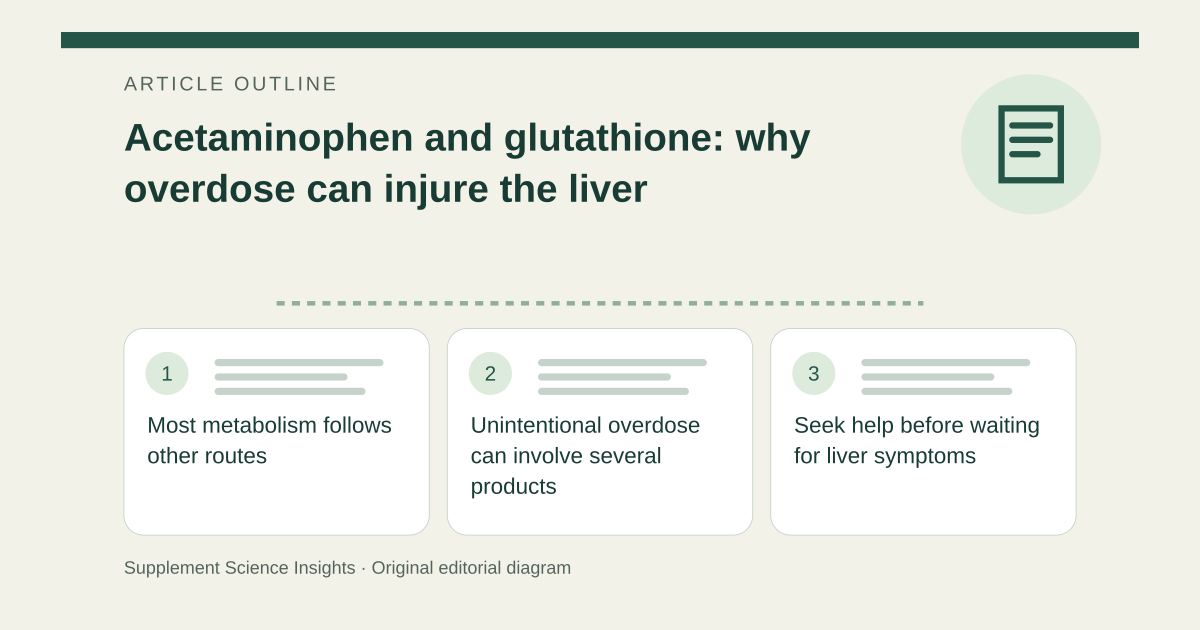
Most metabolism follows other routes
Much of an acetaminophen dose is processed into conjugates that are eliminated. A smaller fraction passes through a pathway that produces a reactive intermediate, commonly abbreviated NAPQI. Glutathione normally helps neutralize this intermediate. [1][2]
If reactive-metabolite formation overwhelms available protection, the intermediate can bind cellular components and contribute to liver injury. This explains why glutathione matters without implying that every correctly used dose causes clinically important depletion. [1][2]
Unintentional overdose can involve several products
Acetaminophen appears in combination cold, pain and sleep products as well as single-ingredient medicines. Taking multiple products without recognizing the shared ingredient can produce an unintended excess. Follow the product and clinician instructions and check active ingredients across products. [1][2]
Nutrition, illness and other factors can affect susceptibility. These factors do not provide a reliable home calculation of a safe excess dose. Symptoms may not reflect the severity early enough to guide a wait-and-see approach. [1][2]
Seek help before waiting for liver symptoms
For a possible overdose, contact Poison Control in the United States at 1-800-222-1222 or seek urgent medical care. Do not delay assessment while trying glutathione or NAC supplements. Medical acetylcysteine treatment is time-sensitive and depends on the exposure and clinical evaluation. [1][2]
The cited LiverTox overview explains the mechanism and established antidote role. Its older dosing discussion is not reproduced here as a current treatment protocol. Clinicians and poison specialists determine the appropriate regimen. [1][2]
Two brand names can share one active ingredient
Imagine someone uses a cold remedy and a separate pain product. Different packaging does not establish different ingredients. Checking both active-ingredient lists can reveal that each contains acetaminophen; the total exposure matters.
| Observation | What it means |
|---|---|
| Different product names | May still contain acetaminophen |
| Glutathione protection | Can be overwhelmed |
| Possible overdose | Prompt poison-specialist or medical assessment |
Sources for this article
- LiverTox: Acetaminophen
Source consulted: 2026-09-17. This is a reference resource, not a claim that we conducted the studies or tested a product. - LiverTox: Acetylcysteine
Source consulted: 2026-09-17. This is a reference resource, not a claim that we conducted the studies or tested a product.