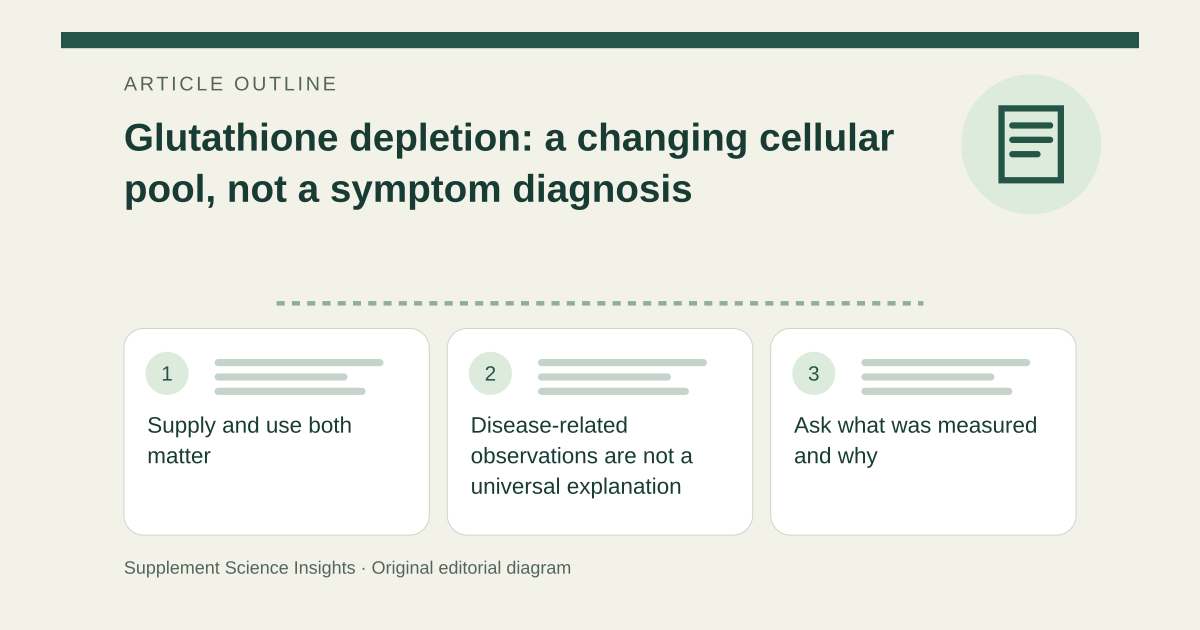
Supply and use both matter
Cells build glutathione from amino-acid precursors and recycle oxidized glutathione back to its reduced form. At the same time, glutathione participates in chemical reactions and can leave the cell. The measured pool reflects these processes together. [1][2]
The foundational review describes severe oxidative stress exceeding recycling capacity and leading to export or other changes in glutathione handling. A decline therefore need not mean that dietary supply alone is inadequate. [1][2]
Disease-related observations are not a universal explanation
The LiverTox acetylcysteine overview discusses glutathione depletion in settings such as malnutrition, chronic debilitating illness and acetaminophen overdose. These are defined clinical contexts with different causes and management. [1][2]
It would be misleading to convert those observations into a claim that ordinary tiredness establishes low glutathione. It would also be misleading to assume that a higher dose of a supplement corrects every reason a cellular pool might be reduced. [1][2]
Ask what was measured and why
A result needs the sample type, measured form and clinical purpose. Blood measurements and intracellular pools in different organs are not interchangeable descriptions. A change in reduced glutathione also differs from a change in the combined reduced and oxidized pool. [1][2]
The sources here explain mechanisms and selected clinical settings. They do not provide a validated symptom checklist, a general screening program or a target concentration for healthy consumers. [1][2]
A smaller pool does not identify the responsible pathway
Imagine a reservoir shrinks because output rises while input stays constant. Adding input might change its level, but the observation alone did not show that input was originally deficient. This analogy illustrates the difference between a measured pool and its underlying causes.
| Observation | What it means |
|---|---|
| Less synthesis | One possible contributor |
| Greater use or export | Other possible contributors |
| Low measured value | Needs context and interpretation |
Sources for this article
- Lu: Glutathione synthesis — foundational mechanistic review
Source consulted: 2026-09-17. This is a reference resource, not a claim that we conducted the studies or tested a product. - LiverTox: Acetylcysteine
Source consulted: 2026-09-17. This is a reference resource, not a claim that we conducted the studies or tested a product.