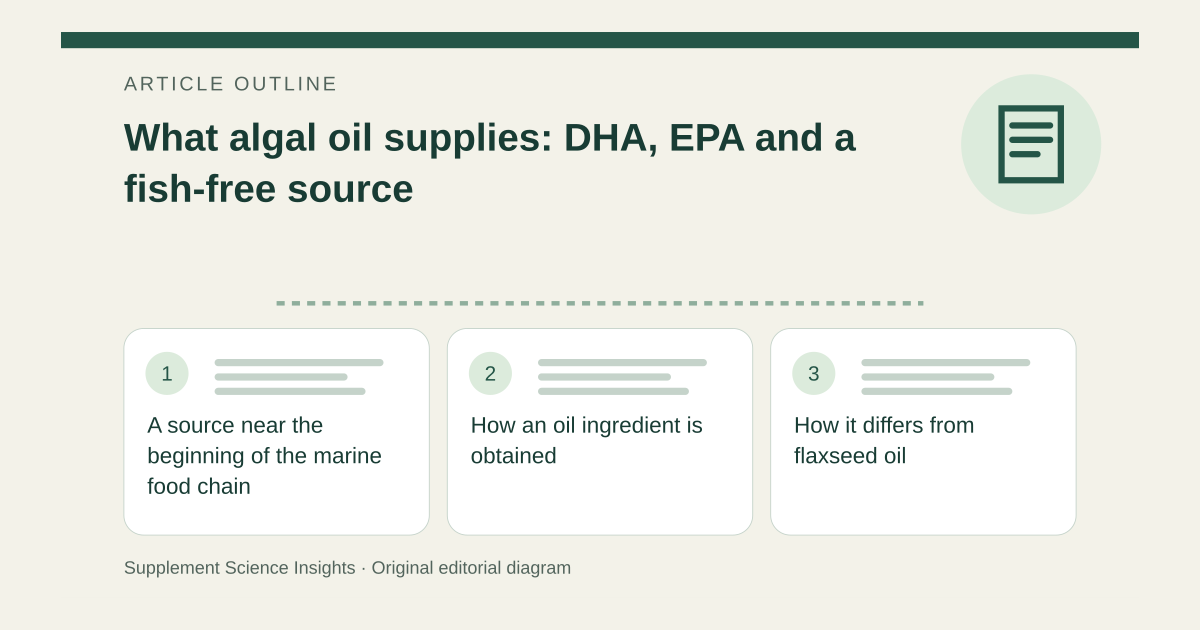
A source near the beginning of the marine food chain
Microalgae synthesize long-chain omega-3 fatty acids that can later accumulate in fish. Algal oil obtains these fats from cultivated organisms rather than extracting them from fish. It is often described as a plant-based or fish-free omega-3 source, although microalgae are a diverse biological group. [1]
The nutritional question is which fatty acids the oil supplies. DHA and EPA are distinct omega-3s, and an algal oil may be rich in DHA without providing an equal amount of EPA. The word algae does not establish a fixed formula. [1]
How an oil ingredient is obtained
A documented FDA notice for a Schizochytrium-derived oil describes controlled cultivation, recovery of oil from the cells and refining steps. That example shows how an oil ingredient differs from simply consuming a whole algal biomass. [2]
The species or strain and the processing specifications matter. A notice for one oil does not certify every algae supplement, and a refined oil should not be assumed to contain all the components of the original organism. [2]
How it differs from flaxseed oil
Flaxseed oil mainly supplies alpha-linolenic acid, ALA. The body can convert some ALA into EPA and DHA, but NIH describes that conversion as limited. An algal product containing DHA supplies that named fatty acid directly. [1]
This distinction does not mean that ALA has no nutritional value. ALA is itself an essential fatty acid. It means that equal total omega-3 amounts from ALA-rich oil and DHA-rich oil do not represent the same fatty-acid mixture, so the intended comparison must be stated clearly. [1]
Reading a hypothetical serving
Suppose an algal capsule contains 500 mg of oil and declares 250 mg DHA but no EPA amount. The oil weight is not the DHA weight, and the label does not justify assuming 250 mg EPA as well. If vegan status matters, check the capsule and the complete formulation in addition to the algal source. [1][2]
| Hypothetical entry | Interpretation |
|---|---|
| 500 mg algal oil | Total declared oil mass |
| 250 mg DHA | Named DHA amount |
| EPA not declared | Do not infer a matching EPA amount |
Sources for this article
- Omega-3 Fatty Acids - Health Professional Fact Sheet
Source consulted: 2026-09-20. This is a reference resource, not a claim that we conducted the studies or tested a product. - GRAS-Notice-GRN-844-Agency-Response-Letter -Algal oil (55% docosahexaenoic acid) from Schizochytrium sp. strain FCC-3204
Source consulted: 2026-09-20. This is a reference resource, not a claim that we conducted the studies or tested a product.