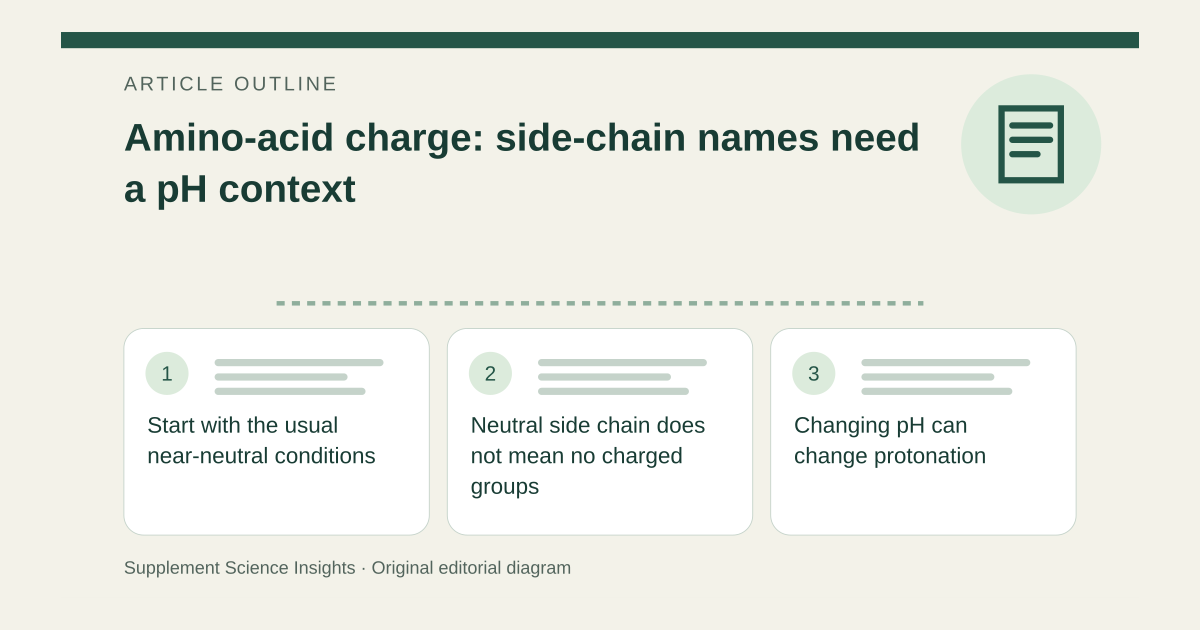
Start with the usual near-neutral conditions
Aspartate and glutamate usually have negatively charged side chains near physiological pH, while lysine and arginine usually have positively charged side chains. Histidine is grouped as basic but its side chain is mostly unprotonated around pH 7.3. A category name is less precise than the actual chemical conditions. [1]
Neutral side chain does not mean no charged groups
A free amino acid can contain both a positively charged amino group and a negatively charged carboxylate group. This dipolar form is called a zwitterion. An overall net charge of zero therefore does not imply that all of its groups are uncharged. [1]
Within a peptide, many backbone amino and carboxyl groups participate in bonds, so the free amino acid and the same residue in a protein are not identical charge calculations. [1]
Changing pH can change protonation
A group can gain or lose a proton as conditions change. The side chains of tyrosine and cysteine, usually placed in neutral categories, can lose protons at sufficiently alkaline pH. Classification tables summarize a context rather than impose a permanent charge. [1]
These chemical labels do not establish that a food or supplement alkalinizes the body or treats an acid–base disorder. That would be a separate physiological and clinical claim. [1]
Distinguish local charges from net charge
Imagine a simplified molecule contains one positive and one negative group. The charges sum to zero, yet both charged sites remain present. Calling the whole molecule net-neutral does not erase those local interactions.
| Feature | Interpretation |
|---|---|
| One positive group | Local positive charge |
| One negative group | Local negative charge |
| Sum of those charges | Zero net charge |
Sources for this article
- OpenStax Organic Chemistry: Structures of Amino Acids
Source consulted: 2026-09-17. This is a reference resource, not a claim that we conducted the studies or tested a product.