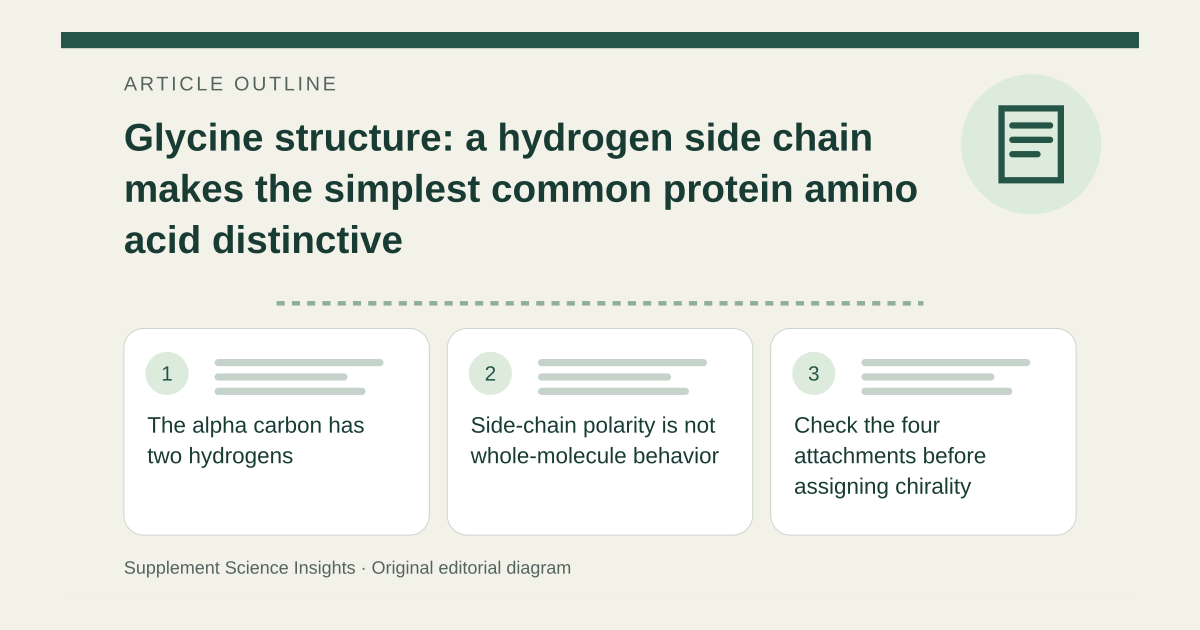
The alpha carbon has two hydrogens
Glycine has the uncharged structural shorthand H2N–CH2–CO2H. One of the hydrogens corresponds to the side-chain position in a general amino-acid diagram. Its alpha carbon therefore does not have four different attached groups and is not a chirality center. [1][2]
This distinguishes glycine from the other common protein amino acids. It also means a claim that every amino acid must be designated L or D overlooks this particular structural exception. [1][2]
Side-chain polarity is not whole-molecule behavior
Glycine is commonly placed in a nonpolar side-chain category because that side chain is only hydrogen. The free molecule still has amino and carboxyl groups that can be charged, including a zwitterionic form in water. [1][2]
Consequently, calling the side chain nonpolar does not mean the whole molecule behaves like an oil. Be clear whether a statement concerns the side chain, the free amino acid or a glycine residue within a protein. Those are related but different chemical contexts. [1][2]
Check the four attachments before assigning chirality
Imagine a central carbon attached to an amino group, a carboxyl group and two hydrogens. Because two attachments match, that carbon is not a chirality center. Replacing one hydrogen with a different side chain changes the structural question.
| Feature | Interpretation |
|---|---|
| Side chain | Hydrogen |
| Hydrogens on alpha carbon | Two |
| Alpha-carbon chirality center | Absent |
Sources for this article
- OpenStax Organic Chemistry: Structures of Amino Acids
Source consulted: 2026-09-17. This is a reference resource, not a claim that we conducted the studies or tested a product. - OpenStax Biology 2e: Proteins
Source consulted: 2026-09-17. This is a reference resource, not a claim that we conducted the studies or tested a product.