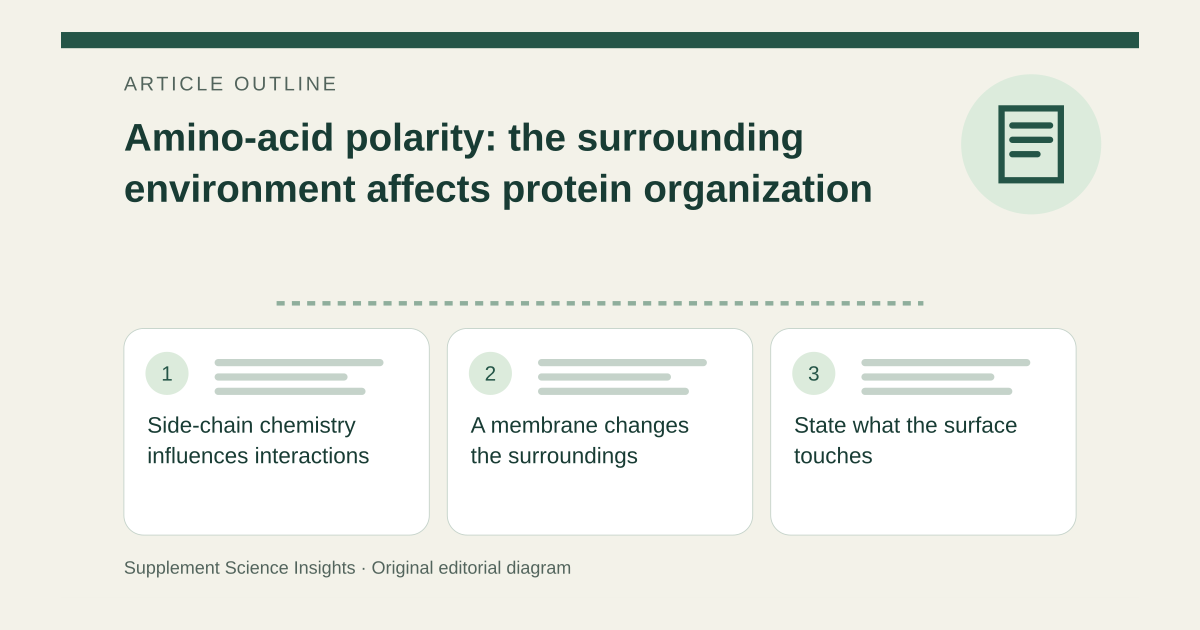
Side-chain chemistry influences interactions
To assess a side chain, look for charged groups or oxygen/nitrogen groups that can interact with water, rather than classifying the whole amino acid by its shared backbone. Common nonpolar examples include alanine, valine, leucine, isoleucine and methionine. Serine, threonine, asparagine and glutamine have polar uncharged side chains; aspartate and glutamate are negatively charged, while lysine and arginine are positively charged near physiological pH. Aromatic rings need closer inspection: a largely hydrocarbon ring and a ring bearing a polar group do not have identical chemistry. Classification describes tendencies, with ionization and the surrounding environment affecting behavior. [1]
Nonpolar side chains, such as those of valine and alanine, interact differently with water from polar side chains such as those of serine and threonine. Charged groups add another type of interaction. These distinctions concern chemical behavior, not the dietary importance of the amino acid. [1]
In many soluble proteins, nonpolar groups tend to become less exposed to water while polar groups often face the aqueous surroundings. This is a tendency in a particular environment, not a rule that every residue must occupy one location. [1]
A membrane changes the surroundings
A protein embedded in a lipid membrane encounters an environment different from a protein dissolved in water. Surface placement must be interpreted in relation to those surroundings. A residue facing lipid is not equivalent to one facing the watery exterior. [1]
Protein folding also involves backbone interactions, charge, sequence and other factors. Labeling a side chain hydrophobic does not alone predict a complete structure, biological function or how a supplement will behave in a person. [1]
State what the surface touches
Imagine two protein surfaces: one contacts water and another contacts membrane lipid. The same side-chain distribution need not be favorable in both. A statement about the outside of a protein is incomplete until the surrounding material is specified.
| Feature | Interpretation |
|---|---|
| Surface exposed to water | An aqueous environment |
| Surface exposed to lipid | A different environment |
| Polarity category | One contributor to behavior |
Sources for this article
- OpenStax Biology 2e: Proteins
Source consulted: 2026-09-17. This is a reference resource, not a claim that we conducted the studies or tested a product.