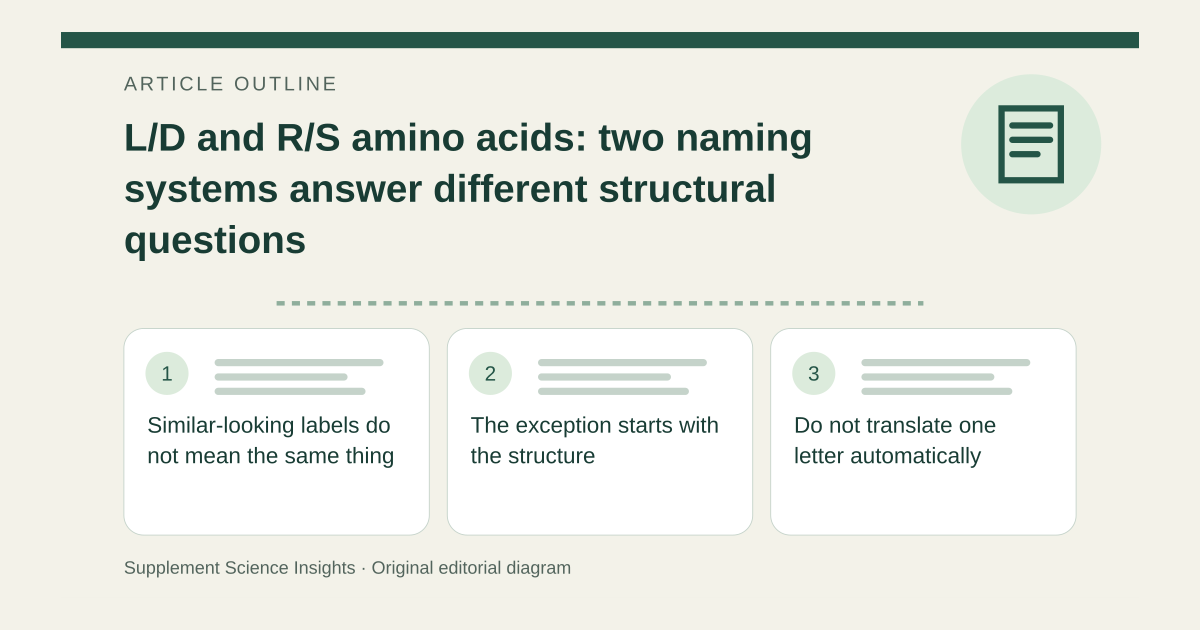
Similar-looking labels do not mean the same thing
For a conventional amino-acid Fischer projection, put the carboxyl group at the top and the side chain at the bottom: an amino group on the left indicates L and on the right indicates D. For an open-chain sugar drawn with the carbonyl end toward the top, inspect the chiral carbon farthest from that carbonyl: hydroxyl on the right indicates D and on the left indicates L. Use the correctly oriented projection, not the apparent left/right position in an arbitrary drawing. A sugar’s D/L label does not specify every stereocenter or the direction it rotates polarized light. [1][2]
The common chiral amino acids used in ordinary protein synthesis have the L configuration. R and S describe configuration using a different set of ordering rules. L therefore does not mean S in every molecule, and D does not simply mean R. [1][2]
Cysteine illustrates the distinction: L-cysteine has an R alpha-carbon configuration, while most common L protein amino acids have S at that position. The difference concerns the priority rules applied to the attached groups, not a claim that cysteine is a different nutritional category. [1][2]
The exception starts with the structure
Glycine’s alpha carbon carries two hydrogens and is not a chirality center. Assigning an L or D alpha-carbon label to it as though it had four distinct attachments misses this feature. [1]
Configuration also is not a supplement quality score. A stereochemical name identifies a structural property, not a demonstrated health benefit or a guarantee that two preparations are interchangeable. Read the exact compound and intended use separately from the naming convention. [1]
Do not translate one letter automatically
Imagine a comparison sheet turns every L label into S. It would misdescribe L-cysteine. A correct conversion requires examining the structure and priority rules, rather than applying a find-and-replace rule to names.
| Description | Interpretation |
|---|---|
| L/D | Relative configuration convention |
| R/S | Priority-based configuration convention |
| Glycine alpha carbon | Not a chirality center |
Sources for this article
- OpenStax Organic Chemistry: Structures of Amino Acids
Source consulted: 2026-09-17. This is a reference resource, not a claim that we conducted the studies or tested a product. - OpenStax Organic Chemistry: D,L Sugars
Source consulted: 2026-09-20. This is a reference resource, not a claim that we conducted the studies or tested a product.