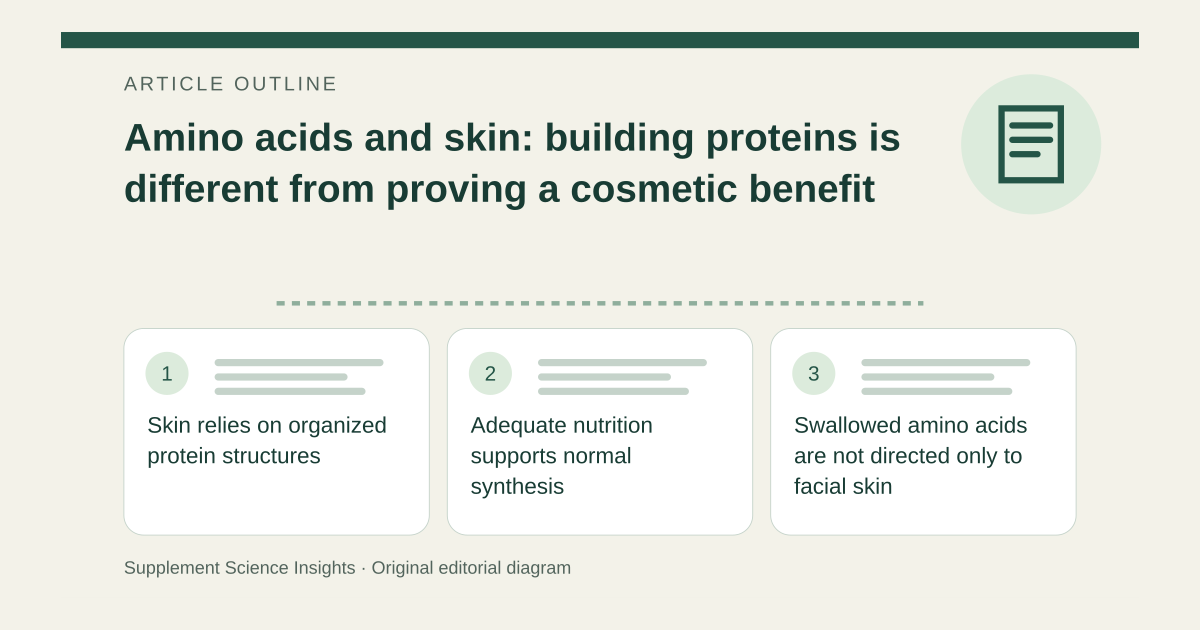
Skin relies on organized protein structures
Amino acids are building blocks for proteins used in tissue growth and repair. Collagen provides a useful example: its triple-helical structure depends on repeated glycine positions and substantial proline content. The order, cellular processing and assembly matter as well as the ingredients. [1][2]
Adequate nutrition supports normal synthesis
Dietary protein supplies amino acids, while vitamin C participates in collagen synthesis. Correcting inadequate intake is different from showing that more of a precursor improves skin when needs are already met. A nutrient’s necessary role does not establish a universal beauty-supplement dose. [3][4]
Swallowed amino acids are not directed only to facial skin
The body uses amino acids across tissues and functions. An oral powder’s label cannot establish that its contents become collagen at a chosen facial site. A claim about improved skin needs evidence on the actual product and outcome, not simply a list of collagen-associated amino acids. [1][2]
Topical comfort and structural change are separate outcomes
A cosmetic may make skin feel better moisturized, but that is not the same as proving new dermal collagen or lasting wrinkle reduction. A finished formulation must be assessed for its actual effect and tolerance; an amino-acid ingredient list alone does not settle the result. [5][2]
Ask what benefit was actually measured
Imagine a serum lists glycine and proline while advertising firmer skin. Their role in collagen explains an ingredient rationale, not a demonstrated outcome for that serum. Look for matched human product evidence and keep ordinary nutrition and skin care in perspective. [2][3]
| Evidence | Does not establish |
|---|---|
| Amino acids form proteins | Extra intake improves every skin concern |
| Collagen contains glycine and proline | A powder rebuilds one facial area |
| Skin feels moisturized | Permanent structural change |
Sources for this article
- Amino acids: MedlinePlus Medical Encyclopedia
Source consulted: 2026-09-21. This is a reference resource, not a claim that we conducted the studies or tested a product. - The Extracellular Matrix of Animals - Molecular Biology of the Cell - NCBI Bookshelf
Source consulted: 2026-09-21. This is a reference resource, not a claim that we conducted the studies or tested a product. - Protein in diet: MedlinePlus Medical Encyclopedia
Source consulted: 2026-09-21. This is a reference resource, not a claim that we conducted the studies or tested a product. - Vitamin C - Health Professional Fact Sheet
Source consulted: 2026-09-21. This is a reference resource, not a claim that we conducted the studies or tested a product. - How to pick the right moisturizer for your skin
Source consulted: 2026-09-21. This is a reference resource, not a claim that we conducted the studies or tested a product.