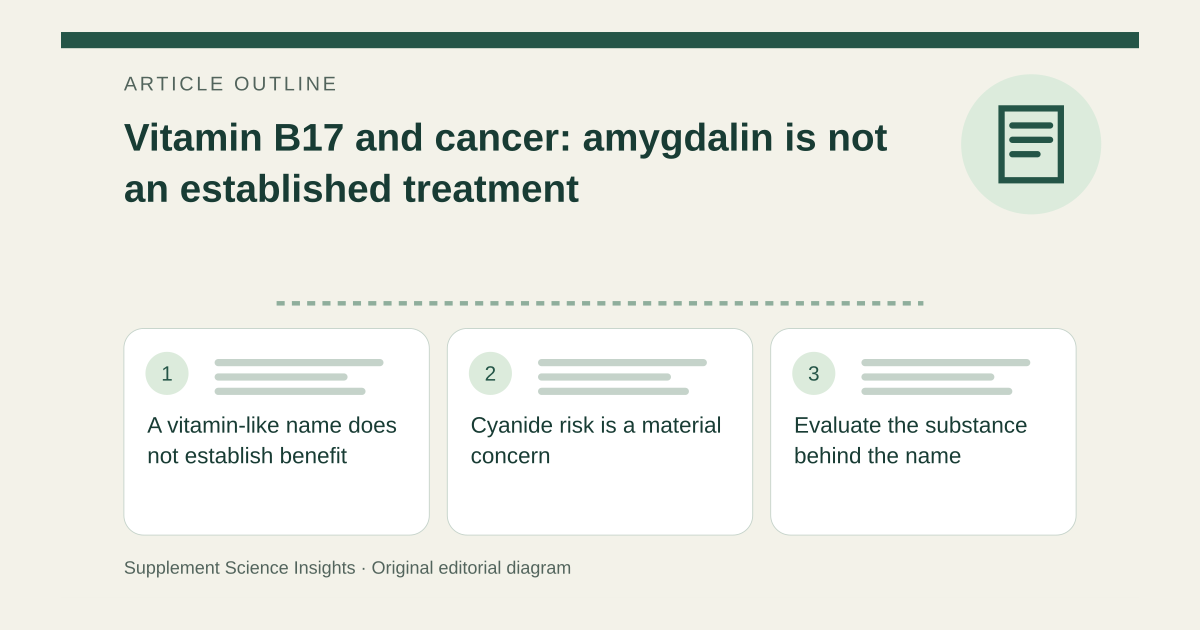
A vitamin-like name does not establish benefit
The National Cancer Institute’s PDQ summary reports no controlled clinical trials establishing laetrile as an effective cancer treatment and explains that anecdotal reports do not demonstrate efficacy. FDA has not approved it as a treatment for cancer or another medical condition. [1]
Laboratory claims or testimonials should not be used to replace established cancer care. A substance being derived from plants or fruit pits does not establish either effectiveness or safety. [1]
Cyanide risk is a material concern
NCI describes serious adverse effects, including neurological injury, very low blood pressure, coma and death. Oral use can cause worse toxicity, and high-dose vitamin C can increase the risk in this context. [1]
Do not infer that an injectable preparation is safe because oral use can be more hazardous. Neither route is established as an effective cancer treatment by the cited evidence. [1]
Evaluate the substance behind the name
Imagine a product is advertised as a missing vitamin needed to fight cancer. Identify the actual ingredient and human evidence. Calling amygdalin B17 does not create a recognized deficiency disease or a proven anticancer benefit.
| Detail | Interpretation |
|---|---|
| Vitamin B17 label | Marketing name |
| Human efficacy | Not established |
| Cyanide exposure | Can be severe |
Sources for this article
- Laetrile/Amygdalin - NCI
Source consulted: 2026-09-17. This is a reference resource, not a claim that we conducted the studies or tested a product.