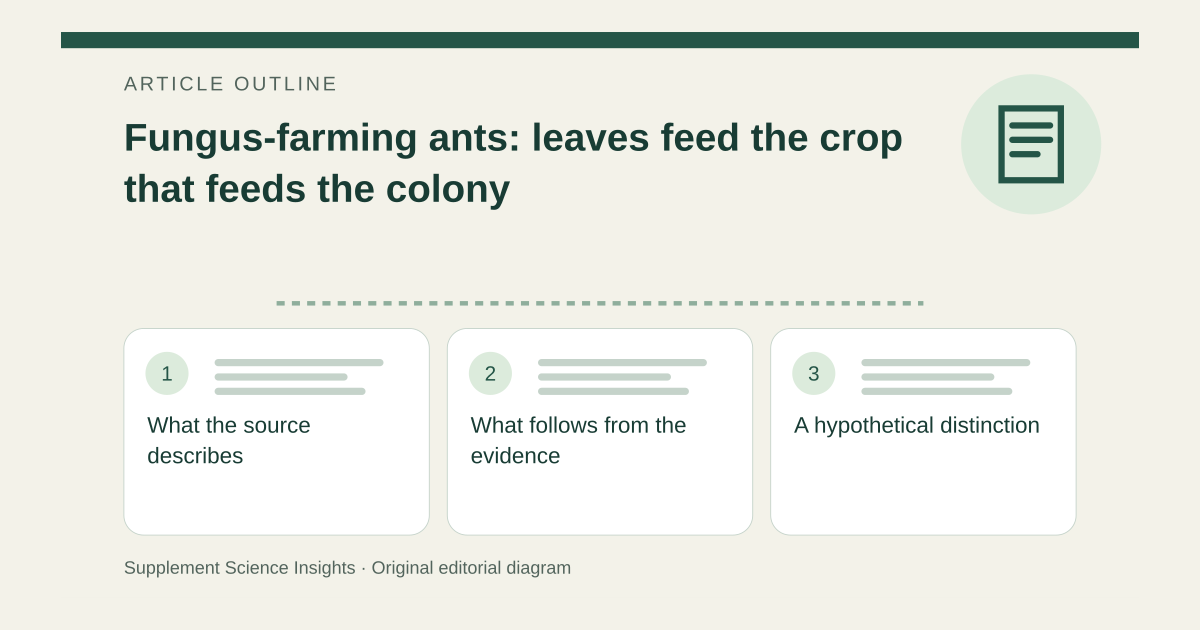
What the source describes
A 2024 Smithsonian research account describes fungi producing food structures called gongylidia for the ants. It distinguishes different agricultural systems among fungus-farming ants. [1]
The reported study compared genetic data across hundreds of fungal and ant species to reconstruct their shared history. The evolutionary dates are inferences from those comparisons, not direct observations of ancient colonies. [1]
What follows from the evidence
The institutional account is a summary of the research, not an independent appraisal reproduced here. Its description does not mean every ant farms fungi or every cultivated fungus forms a familiar mushroom cap. The partnership involves particular organisms and cultivation strategies. [1]
A hypothetical distinction
Imagine an ant carries a leaf fragment underground. The fragment may feed the fungal crop, while the ant later consumes what that crop produces.
| Detail | Interpretation |
|---|---|
| Vegetation | Substrate for the crop |
| Fungal structures | Food for ants |
| Farming behavior | Occurs in particular groups |
Sources for this article
- Ant Agriculture Began 66 Million Years Ago in the Aftermath of the Asteroid That Doomed the Dinosaurs | Smithsonian Institution
Source consulted: 2026-09-19. This is a reference resource, not a claim that we conducted the studies or tested a product.