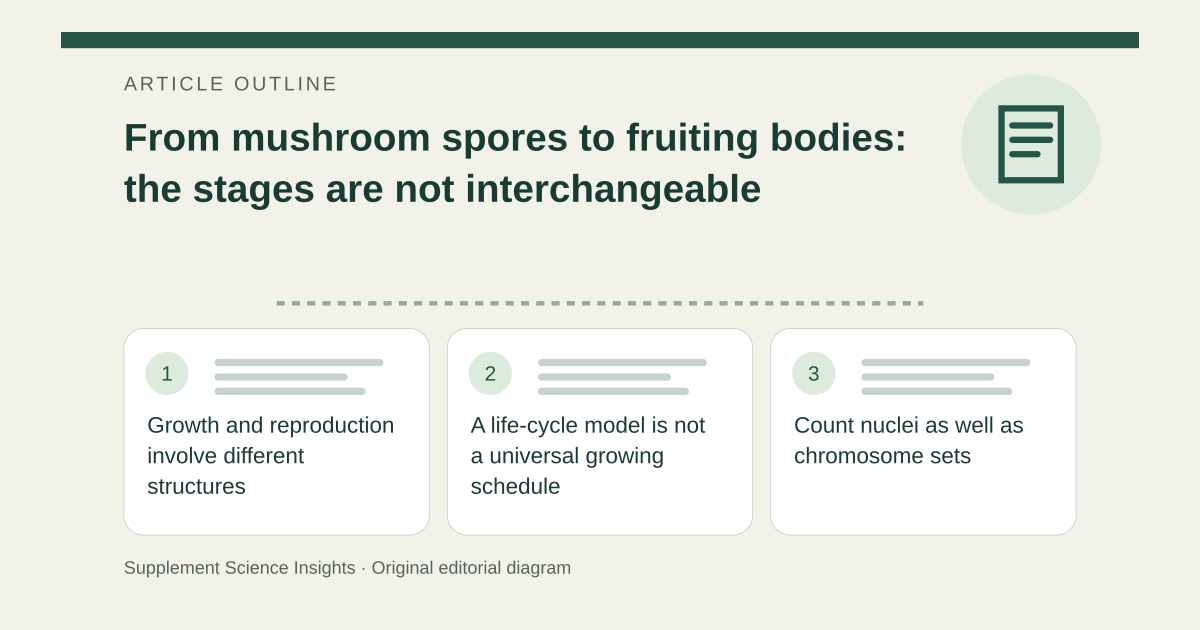
Growth and reproduction involve different structures
In the typical cycle, a spore germinates into hyphae, which form a mycelium. Compatible mycelia can combine to produce a stage whose cells contain two separate haploid nuclei. A fruiting body later develops from this network. [1]
Nuclear fusion and meiosis occur in the basidia before new sexual spores form. The two-nucleus stage is called dikaryotic; it should not simply be labeled diploid. [1]
A life-cycle model is not a universal growing schedule
The diagram explains a common basidiomycete pattern. It does not specify how many days an unknown species takes to fruit or guarantee that every dispersed spore will establish a new organism. [1]
When reading cultivation or supplement terminology, identify whether the discussion concerns spores, vegetative mycelium or a harvested fruiting body. Those words name different biological materials; the cycle alone cannot establish their chemical equivalence or nutritional value. [1]
Count nuclei as well as chromosome sets
Imagine a cell contains two unfused haploid nuclei. Drawing them as one diploid nucleus would erase a biologically meaningful stage, even though both diagrams appear to contain two chromosome sets overall.
| Detail | Interpretation |
|---|---|
| Spore | Dispersal and germination stage |
| Mycelium | Network of filaments |
| Dikaryotic | Two separate nuclei |
Sources for this article
- 24.2 Classifications of Fungi - Biology 2e | OpenStax
Source consulted: 2026-09-19. This is a reference resource, not a claim that we conducted the studies or tested a product.