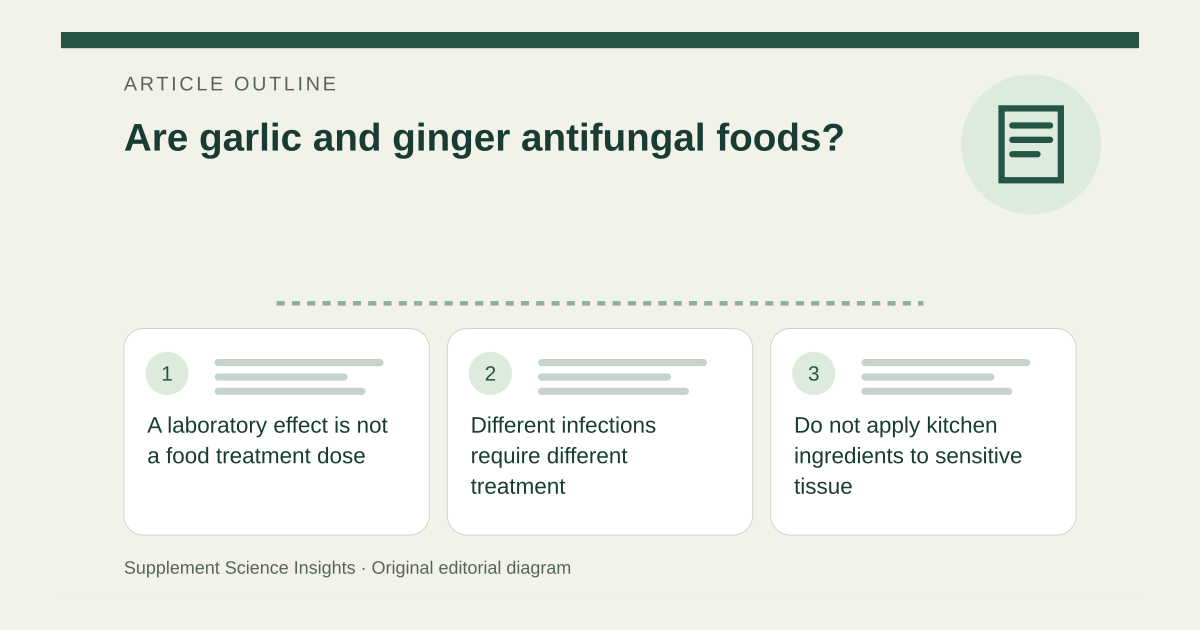
A laboratory effect is not a food treatment dose
Testing an isolated compound against a fungus does not show that eating the source food delivers the same exposure at an infected site. Ginger’s general biological activity cannot validate an antifungal diet or a homemade topical preparation. [1][2]
Different infections require different treatment
CDC describes distinct treatments for vaginal candidiasis, oral thrush, esophageal disease and invasive infection. Severe or recurrent disease may require testing and a different medicine. A food list cannot substitute for those distinctions. [3]
Do not apply kitchen ingredients to sensitive tissue
Raw ginger and concentrated oils can irritate skin and mucosa. Do not insert garlic, ginger or essential oils to treat a presumed yeast infection. A symptom that resembles a familiar infection can have another cause. [4][5][3]
Keep ordinary food choices separate from cure claims
Imagine a meal contains garlic and ginger while someone is being treated for thrush. The meal can be enjoyed if tolerated, but it does not replace the prescribed course. Seek review if symptoms recur or fail to improve. [3]
| Evidence | Cannot establish |
|---|---|
| Laboratory inhibition | Clinical cure from eating food |
| Natural ingredient | Safe on mucosal tissue |
| Recurrent symptoms | Same diagnosis every time |
| Food alongside treatment | Replacement for medicine |
Sources for this article
- Clinical dermatologic applications of ginger: a focused review.
Source consulted: 2026-09-21. This is a reference resource, not a claim that we conducted the studies or tested a product. - Dietary Supplements: What You Need to Know
Source consulted: 2026-09-21. This is a reference resource, not a claim that we conducted the studies or tested a product. - Treatment of Candidiasis | Candidiasis | CDC
Source consulted: 2026-09-21. This is a reference resource, not a claim that we conducted the studies or tested a product. - Essential oils: Poisonous when misused | Poison Control
Source consulted: 2026-09-21. This is a reference resource, not a claim that we conducted the studies or tested a product. - Ginger: Usefulness and Safety | NCCIH
Source consulted: 2026-09-21. This is a reference resource, not a claim that we conducted the studies or tested a product.