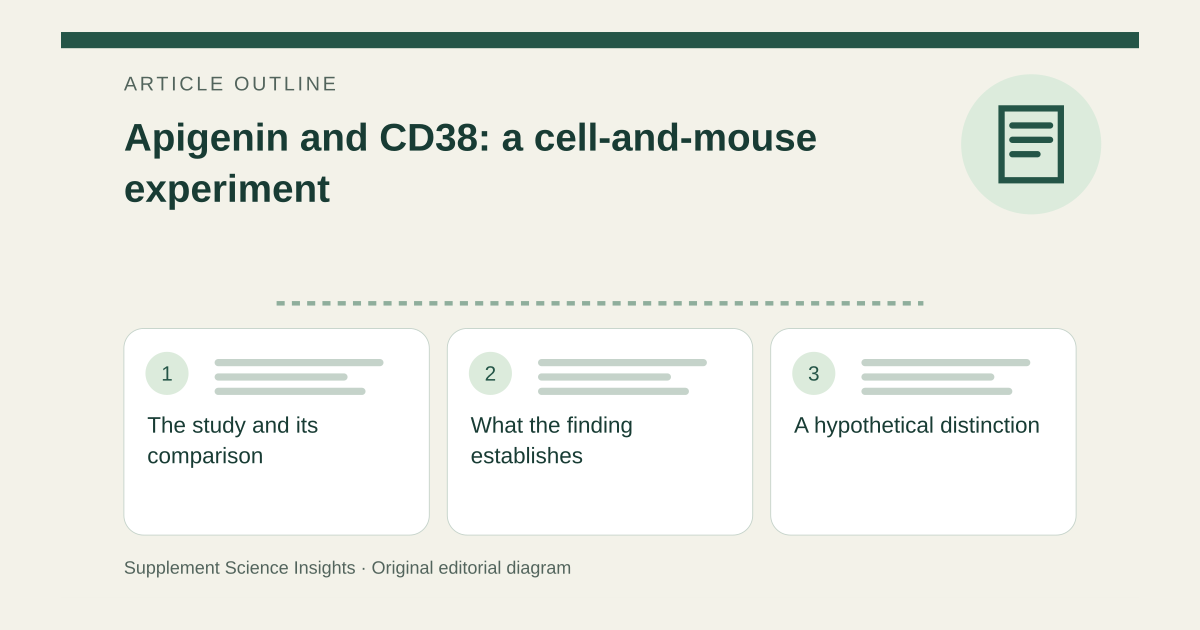
The study and its comparison
Researchers examined an enzyme called CD38, which breaks down NAD, in cell systems and obese mice. They investigated apigenin as an inhibitor and measured NAD levels, protein acetylation and metabolic changes. [1]
Apigenin increased cellular NAD and altered acetylation. Treated obese mice also showed improvements in selected glucose and lipid measures. [1]
What the finding establishes
These are laboratory and animal results, without a human efficacy or long-term safety trial. The abstract does not establish sample sizes or a comparable oral human exposure. Funding and complete conflicts were not established from the retrieved record. A plausible enzyme target does not validate a retail product or a personal dose. [1]
A hypothetical distinction
Imagine a compound changes an enzyme in cultured cells. Absorption, tolerability and meaningful patient outcomes still require separate study.
| Detail | Interpretation |
|---|---|
| Measured outcome | Keep the endpoint specific |
| Study preparation | Not every retail product |
| Remaining uncertainty | Not resolved by a mechanism |
Sources for this article
- Flavonoid apigenin is an inhibitor of the NAD+ ase CD38: implications for cellular NAD+ metabolism, protein acetylation, and treatment of metabolic syndrome.
Source consulted: 2026-09-19. This is a reference resource, not a claim that we conducted the studies or tested a product.