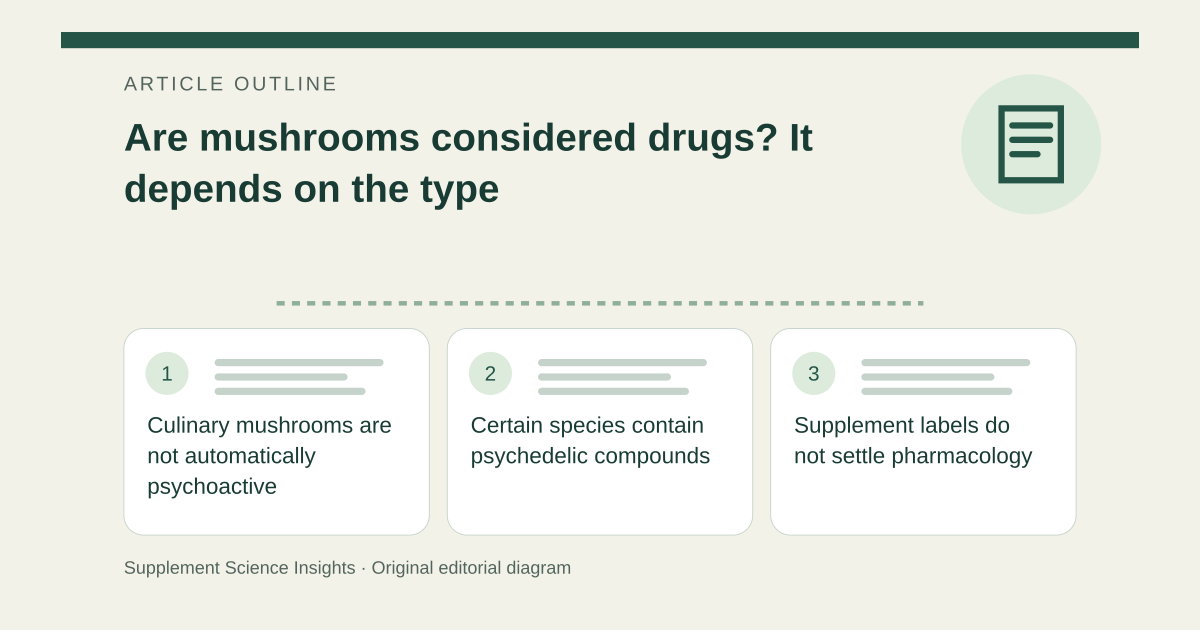
Culinary mushrooms are not automatically psychoactive
Commercial edible mushrooms such as common food varieties are used for nutrition, flavor and texture. Being a fungus does not mean a product contains psilocybin or produces a psychedelic high. [1][2]
Certain species contain psychedelic compounds
Psilocybin and psilocin affect perception, mood and thought. Psilocybin is a controlled substance under United States federal law; local reforms do not automatically mean unrestricted national legality. Laws need checking for the relevant jurisdiction and activity. [2]
Supplement labels do not settle pharmacology
An extract sold for wellness may have biologically active constituents without being equivalent to an approved medicine. Conversely, a candy-like mushroom product can contain psychoactive substances despite its familiar food appearance. [3]
Ask which mushroom and which product
Imagine two packages both say mushroom blend: one is dried soup ingredients and another promises altered perception. The shared word does not establish similar composition, effects or legal status. Read the specific identity rather than reasoning from the category name. [1][2]
| Product | Relevant category |
|---|---|
| Culinary food mushrooms | Food |
| Psilocybin-containing mushrooms | Psychoactive drug exposure |
| Wellness extract | Ingredient-specific supplement assessment |
| Unlabeled gummy | Contents uncertain |
Sources for this article
- Fruit and Vegetable Guide Series: Mushrooms | USU
Source consulted: 2026-09-21. This is a reference resource, not a claim that we conducted the studies or tested a product. - Psilocybin for Mental Health and Addiction: What You Need To Know | NCCIH
Source consulted: 2026-09-21. This is a reference resource, not a claim that we conducted the studies or tested a product. - Psychedelic and Dissociative Drugs | National Institute on Drug Abuse (NIDA)
Source consulted: 2026-09-21. This is a reference resource, not a claim that we conducted the studies or tested a product.