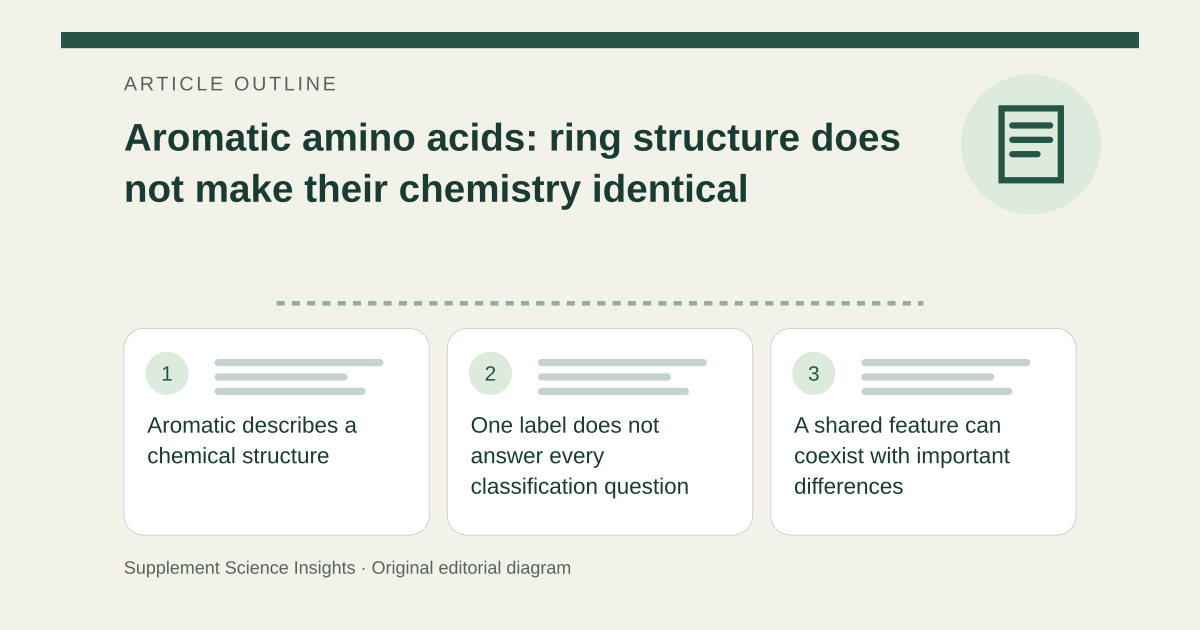
Aromatic describes a chemical structure
In the usual biochemical grouping, phenylalanine, tyrosine and tryptophan have aromatic ring-containing side chains. Aromatic here is a chemistry term; it does not mean that the amino acid is classified by its smell. [1][2]
Phenylalanine has a benzene-containing side chain, tyrosine adds a hydroxyl group to a related ring structure, and tryptophan has an indole ring system. Those differences change the interactions the side chains can make. [1][2]
One label does not answer every classification question
These amino acids contribute residues to proteins, where side-chain chemistry affects interactions and folding. Some also supply precursors for other molecules: tyrosine contributes to catecholamine and thyroid-hormone synthesis, while tryptophan is a precursor for melatonin. Those functions are more specific than saying that every aromatic amino acid has one shared effect. [1][2][3]
Tyrosine’s hydroxyl group gives it properties that differ from phenylalanine. It is usually classified as neutral under near-physiological conditions, but the side chain is weakly acidic and can lose a proton at higher pH. Aromatic and acidic are therefore not mutually exclusive descriptions under every condition. [1][2][3]
A structural category also does not establish that the three amino acids have interchangeable nutritional requirements or supplement effects. For a specific claim, identify the molecule and the biological outcome rather than rely on the ring category alone. [1][2][3]
A shared feature can coexist with important differences
Imagine two molecules share a ring but only one carries a hydroxyl group. Grouping them by the ring preserves one similarity while leaving the added group relevant. A classification is a tool for comparison, not a statement that every property matches.
| Feature | Interpretation |
|---|---|
| Aromatic ring | Shared structural category |
| Additional hydroxyl group | Changes possible interactions |
| Identical supplement effects | Not established by the category |
Sources for this article
- OpenStax Biology 2e: Proteins
Source consulted: 2026-09-17. This is a reference resource, not a claim that we conducted the studies or tested a product. - OpenStax Organic Chemistry: Structures of Amino Acids
Source consulted: 2026-09-17. This is a reference resource, not a claim that we conducted the studies or tested a product. - OpenStax Anatomy and Physiology 2e — Hormones
Source consulted: 2026-09-20. This is a reference resource, not a claim that we conducted the studies or tested a product.