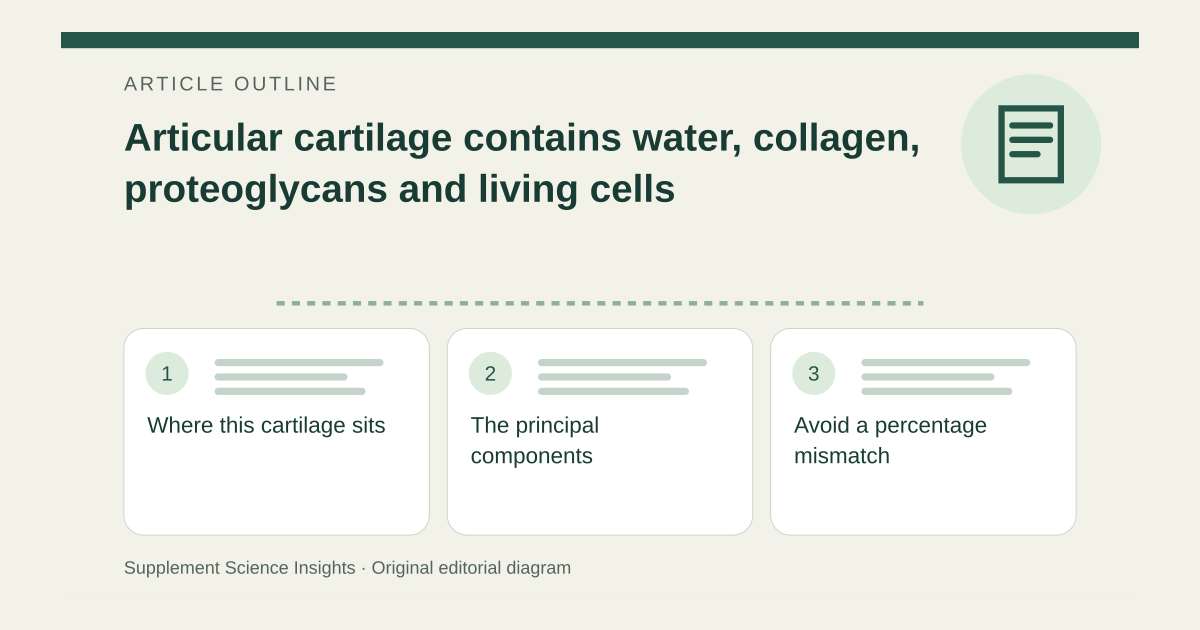
Where this cartilage sits
Articular cartilage covers the ends of bones where they meet in joints, helping surfaces move with little friction. It is a form of hyaline cartilage. AAOS notes its limited intrinsic healing capacity; a damaged joint surface is not equivalent to a simple dietary collagen shortage. [1]
The principal components
The composition review describes chondrocytes within an extracellular matrix rich in water, collagen—predominantly type II—and proteoglycans. Cells maintain their local matrix, while the hydrated molecular network helps the tissue respond to loading. The source is a basic-science review; it does not test an oral supplement or show that consuming a component rebuilds a joint surface. [2]
Avoid a percentage mismatch
Imagine one description reports a constituent as a percentage of wet tissue and another as a percentage of dry matrix. Those figures have different denominators and cannot be compared directly. Likewise, a powder labeled type II collagen is an ingredient description, not an intact cartilage implant or evidence that it repairs a particular injury. [2]
| Hypothetical description | What to keep distinct |
|---|---|
| Wet tissue weight | Includes substantial water |
| Dry matrix weight | Different denominator |
| Oral collagen ingredient | Not the organized joint tissue |
Sources for this article
- Articular Cartilage Restoration - OrthoInfo - AAOS
Source consulted: 2026-09-20. This is a reference resource, not a claim that we conducted the studies or tested a product. - The Basic Science of Articular Cartilage: Structure, Composition, and Function - PMC
Source consulted: 2026-09-20. This is a reference resource, not a claim that we conducted the studies or tested a product.