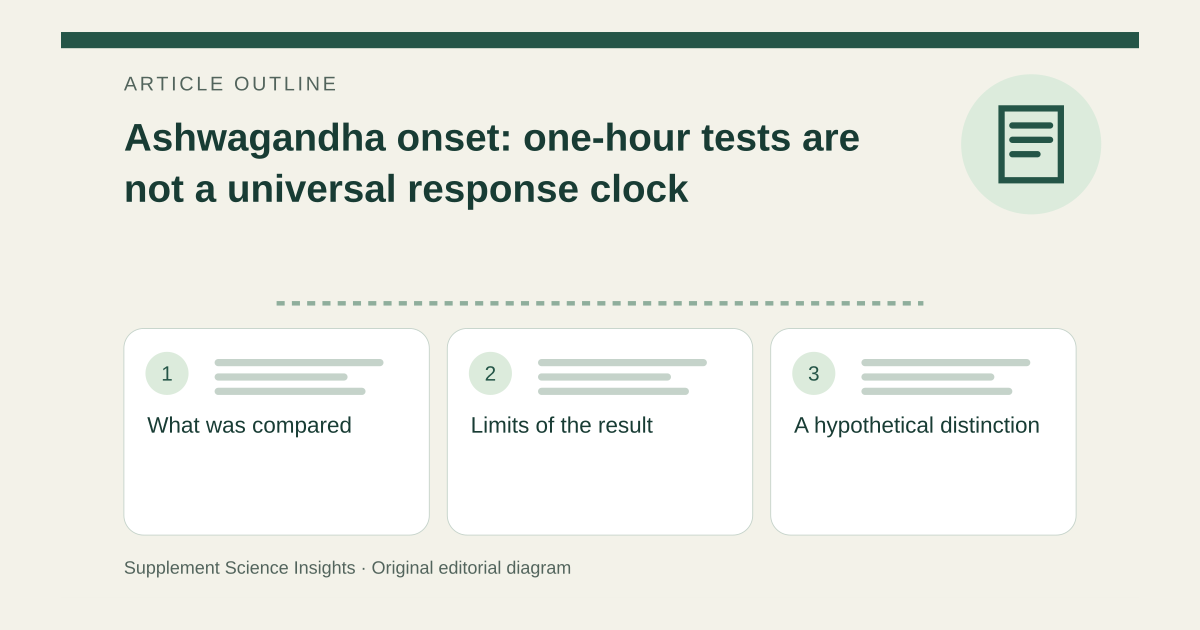
What was compared
Fifty-nine younger adults received a liposomal root-and-leaf extract or placebo in a randomized, double-blind experiment. Cognitive assessments were repeated after 60 minutes and following 30 days of daily use. [1]
The report described changes in selected memory, reaction-time and mood measures, with several group differences. Not every improvement from baseline is evidence of superiority to placebo. [1]
Limits of the result
The trial was registered retrospectively and disclosed industry-affiliated investigators and other professional industry relationships. Funding details were not established from the abstract. Its specific formulation and task battery cannot provide a universal onset time for ordinary root powders or stress relief. [1]
A hypothetical distinction
Imagine researchers choose a one-hour assessment because it fits a protocol. Finding a signal then does not show that the effect starts exactly at one hour or that every participant notices it.
| Detail | Interpretation |
|---|---|
| 59 adults | Small formulation trial |
| One hour and 30 days | Assessment times |
| Universal onset | Not established |
Sources for this article
- Acute and Repeated Ashwagandha Supplementation Improves Markers of Cognitive Function and Mood - PubMed
Source consulted: 2026-09-19. This is a reference resource, not a claim that we conducted the studies or tested a product.