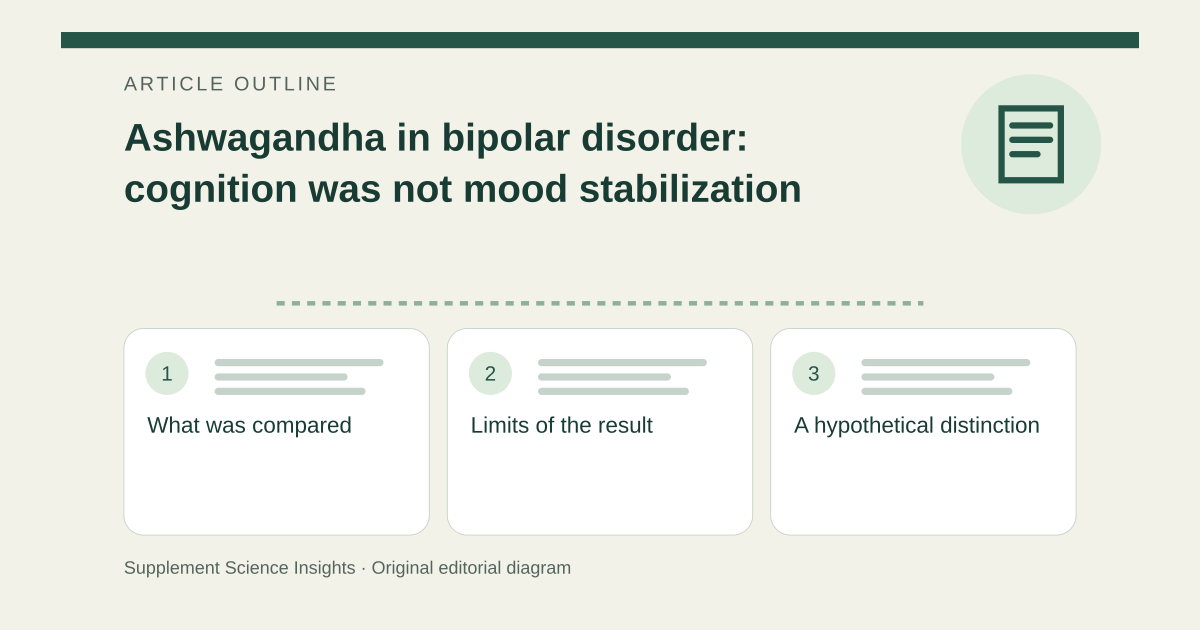
What was compared
Sixty euthymic people with bipolar disorder were randomized to an extract or placebo added to their maintenance medications for eight weeks. Fifty-three completed the study. [1]
Three cognitive tasks favored the extract, including backward digit span; other tasks did not significantly differ. Mood and anxiety scores remained stable. [1]
Limits of the result
Stability during a short study in already stable patients is not proof of relapse prevention or treatment of an active episode. Existing maintenance medicines remained part of the protocol. Funding and conflicts were not established from the abstract. [1]
A hypothetical distinction
Imagine an add-on improves one memory task while a patient continues an established medicine. That does not show the add-on can replace the medicine or control the illness on its own.
| Detail | Interpretation |
|---|---|
| Maintenance medicines | Continued |
| Selected cognitive tasks | Improvement signal |
| Episode prevention | Not established |
Sources for this article
- Randomized placebo-controlled adjunctive study of an extract of withania somnifera for cognitive dysfunction in bipolar disorder - PubMed
Source consulted: 2026-09-19. This is a reference resource, not a claim that we conducted the studies or tested a product.