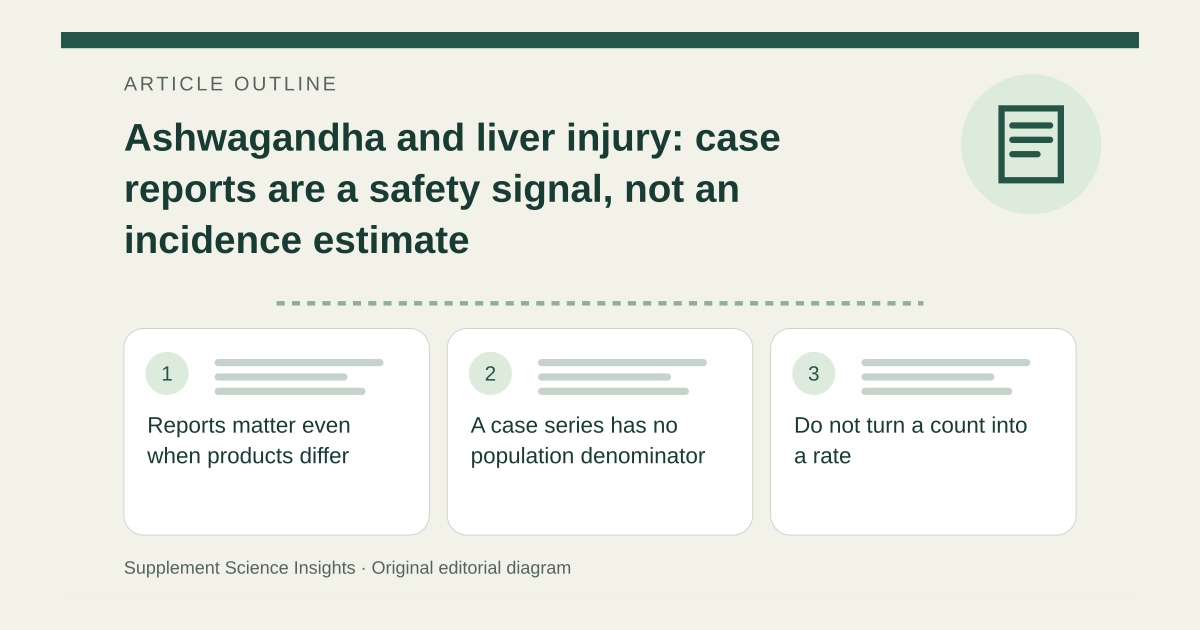
Reports matter even when products differ
ODS describes liver-injury cases associated with ashwagandha use, including a series of five adults. Exposure duration and amounts varied, and some other reports involved combinations or pre-existing liver conditions. Not every product’s contents were independently verified. [1]
Those limitations make causal assessment harder; they do not justify dismissing the reports. Conversely, the reports cannot establish that every ashwagandha preparation carries the same risk or that a particular retail brand is responsible without product-specific evidence. [1]
A case series has no population denominator
Five reported cases are not five cases out of all users. Without a reliable denominator, systematic ascertainment and comparable exposure, a percentage risk cannot be calculated. Failure to see a liver event in a small trial also does not prove zero risk. [1]
A person with liver disease or a suspected reaction needs an individual clinical assessment that includes all medicines and supplements. Do not deliberately restart a suspect product to test causality. The reviewed evidence supplies no marker percentage or cycling schedule guaranteed to avoid injury. [1]
Do not turn a count into a rate
Imagine a report describes five affected users but does not count everyone exposed. It identifies a possible safety problem. Dividing those five cases by an unrelated sales estimate would produce an unreliable rate rather than resolve the missing denominator.
| Observation | Interpretation |
|---|---|
| Affected individuals described | Signal and clinical details |
| Total exposed population | Not established |
| Probability for a new user | Cannot be calculated from the count |
Sources for this article
- NIH ODS: Ashwagandha — Health Professional Fact Sheet
Source consulted: 2026-09-17. This is a reference resource, not a claim that we conducted the studies or tested a product.