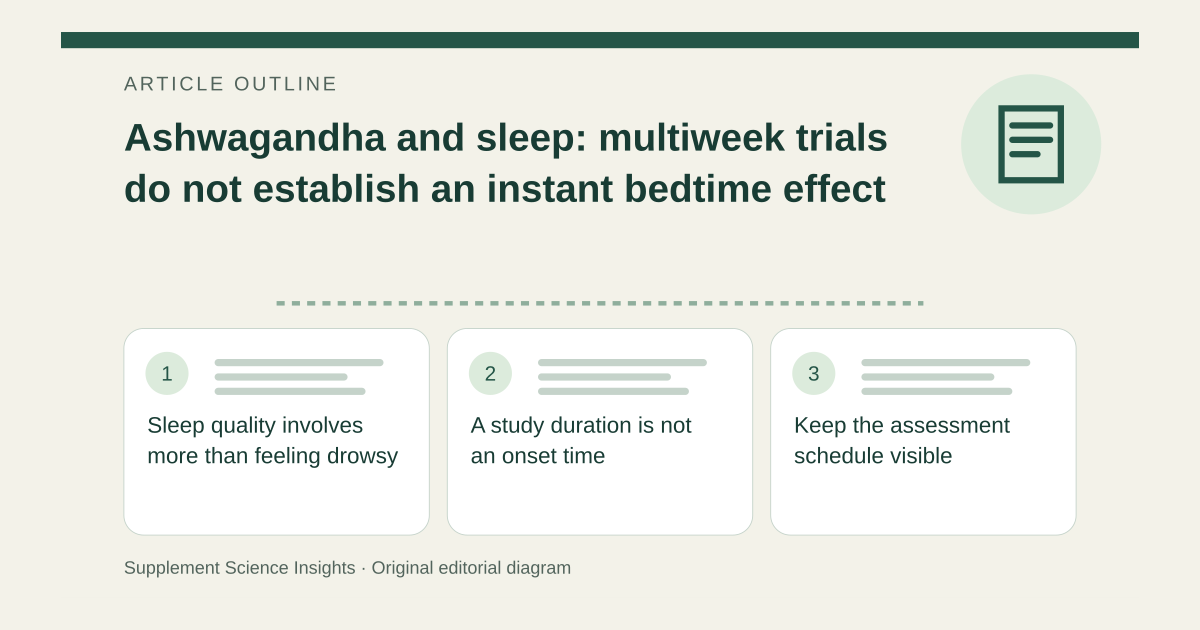
Sleep quality involves more than feeling drowsy
The ODS review describes limited studies measuring sleep quality, time to fall asleep, time asleep and sleep efficiency, the proportion of time in bed spent sleeping. Some used activity-based monitoring as well as questionnaires. These measures answer different questions and should not all be described as sedation. [1]
A 2021 synthesis included five studies with 372 adults in India, generally lasting six to twelve weeks. Average benefits were small, with larger improvements in some insomnia and longer-duration subgroups. A subgroup pattern is not a prescription for a particular extract or dose. [1]
A study duration is not an onset time
An improvement measured at eight weeks does not show that the intervention first started working at eight weeks, nor that it works within an hour. A claim about immediate onset needs measurements designed to test that interval. [1]
Drowsiness is also a reported adverse effect. Feeling sleepy after taking a product does not establish improved restorative sleep or daytime function. Sedative medicines and other health conditions belong in a clinical review before adding ashwagandha. [1]
Keep the assessment schedule visible
Imagine a trial measures sleep at baseline and after eight weeks. The result can describe a change across that period, but it cannot locate the first effective night. A precise bedtime-timing claim would require additional observations.
| Observation | Interpretation |
|---|---|
| Eight-week assessment | Endpoint timing |
| First-night benefit | Not demonstrated by that schedule |
| Minutes before bedtime | Separate unanswered question |
Sources for this article
- NIH ODS: Ashwagandha — Health Professional Fact Sheet
Source consulted: 2026-09-17. This is a reference resource, not a claim that we conducted the studies or tested a product.