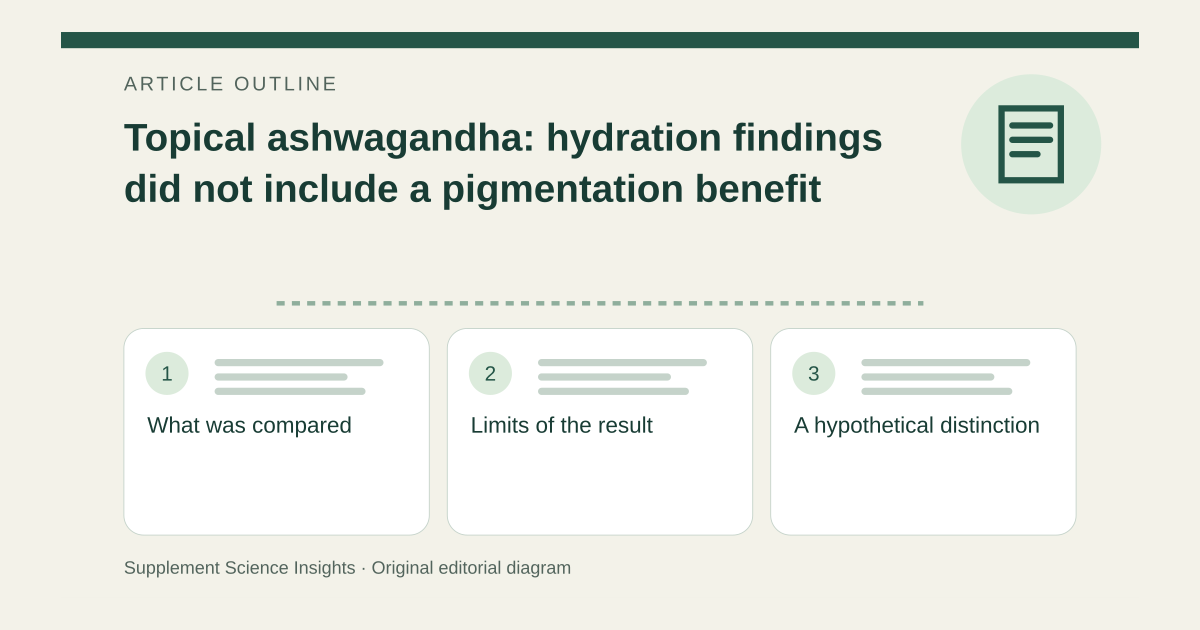
What was compared
Fifty-six adults with photoaged facial skin were randomized to an ashwagandha-containing lotion or matched placebo for 60 days. The per-protocol analysis included 53 participants. [1]
Physician-assessed signs, water-loss measurements, hydration and elasticity favored the active lotion. The change in melanin index did not differ significantly between groups. [1]
Limits of the result
The authors declared no competing interests; funding was not established from the abstract. The tested lotion, skin types and short duration limit generalization. Results do not establish oral-supplement efficacy, skin-cancer prevention or a universal pigmentation treatment. [1]
A hypothetical distinction
Imagine a lotion changes water retention while pigment measurements stay similar. Calling both outcomes skin improvement would conceal a distinction that matters to someone seeking a pigment-specific effect.
| Detail | Interpretation |
|---|---|
| Topical lotion | Route-specific result |
| 53 analyzed | Per-protocol population |
| Melanin index | No significant difference |
Sources for this article
- A Study of Efficacy and Safety of Ashwagandha (Withania somnifera) Lotion on Facial Skin in Photoaged Healthy Adults - PubMed
Source consulted: 2026-09-19. This is a reference resource, not a claim that we conducted the studies or tested a product.