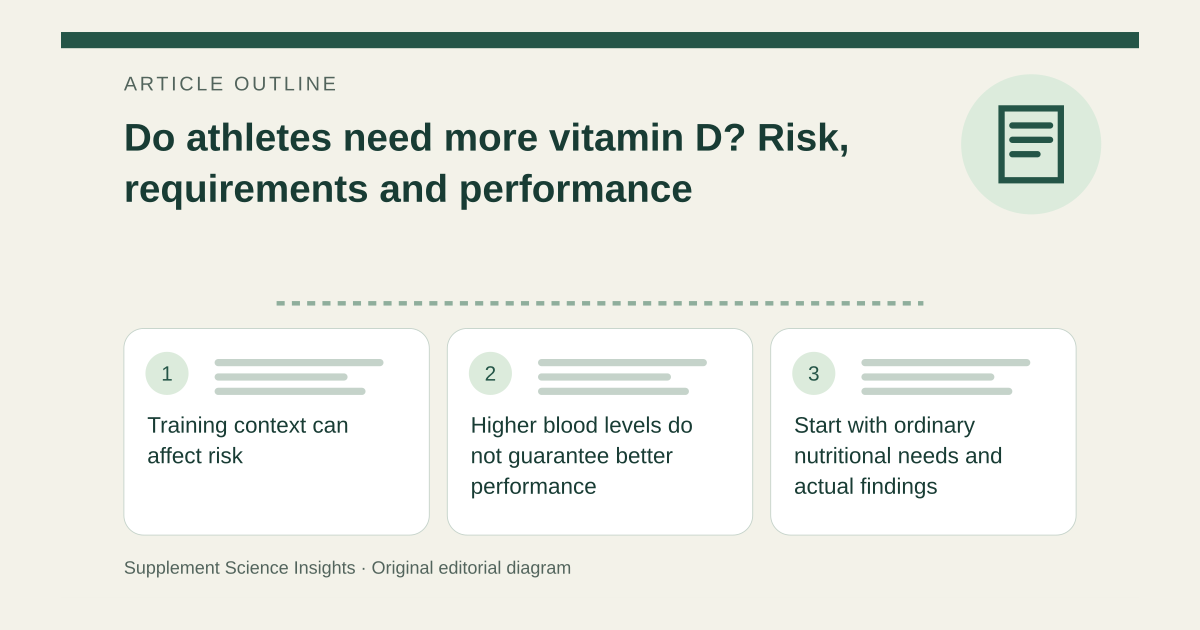
Training context can affect risk
Indoor training, limited UVB exposure and nutritional patterns can influence vitamin D status. A sports-focused review describes frequent inadequacy in studied groups but notes uncertainty about whether all athletes should be treated as a distinct population with higher requirements. The sport label alone cannot determine a dose. [1][2]
Higher blood levels do not guarantee better performance
A 2024 randomized-trial meta-analysis found that supplementation raised vitamin D levels but did not significantly improve the overall pooled strength outcome. One quadriceps-contraction measure favored supplementation. A separate 2023 analysis found no significant overall benefit for maximal strength and power. A selective result is not evidence that every athletic outcome improves. [3][4]
Start with ordinary nutritional needs and actual findings
NIH gives an adult recommended intake of 600 IU daily through age 70 and 800 IU after that, under assumptions of minimal sun exposure. These are total intake recommendations, not sport-specific prescriptions or deficiency-treatment regimens. A clinician or sports dietitian can assess whether an individual needs a different plan. [2]
An ergogenic megadose is not an established shortcut
The usual adult upper intake level is 4,000 IU daily, with medically supervised treatment considered separately. Excess can cause high calcium and kidney complications. An unusually high target blood value or a favorable performance headline does not justify escalating intake indefinitely. [2][1]
Compare two athletes rather than one blanket rule
Imagine an indoor athlete with confirmed deficiency and an outdoor athlete with adequate status. They share a competitive goal but not necessarily a supplementation need. Correct the first person's deficiency appropriately and evaluate training outcomes separately from laboratory improvement. [2][3]
| Question | Relevant evidence |
|---|---|
| Is status inadequate? | Diet, exposure and clinical assessment |
| Do all athletes need extra? | No universal higher requirement established |
| Did the blood level rise? | A biochemical outcome |
| Did performance improve? | Requires the relevant performance measure |
Sources for this article
- Vitamin D, sport and health: a still unresolved clinical issue.
Source consulted: 2026-09-21. This is a reference resource, not a claim that we conducted the studies or tested a product. - Vitamin D - Health Professional Fact Sheet
Source consulted: 2026-09-21. This is a reference resource, not a claim that we conducted the studies or tested a product. - Effects of vitamin D3 supplementation on strength of lower and upper extremities in athletes: an updated systematic review and meta-analysis of randomized controlled trials.
Source consulted: 2026-09-21. This is a reference resource, not a claim that we conducted the studies or tested a product. - Effects of vitamin D supplementation on maximal strength and power in athletes: a systematic review and meta-analysis of randomized controlled trials.
Source consulted: 2026-09-21. This is a reference resource, not a claim that we conducted the studies or tested a product.