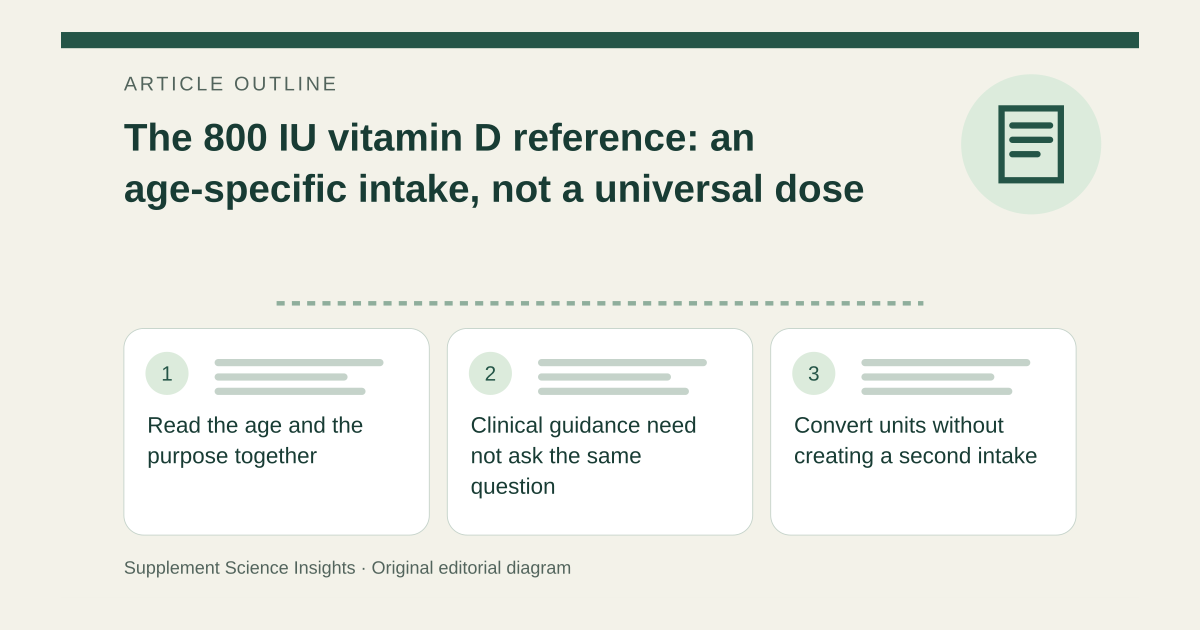
Read the age and the purpose together
The U.S. Food and Nutrition Board values summarized by ODS set an RDA of 20 micrograms, or 800 IU, for adults older than 70. For ages 1–70, including adult pregnancy and lactation, the listed RDA is 15 micrograms, or 600 IU. Infants have a separate adequate intake. [1]
The references assume minimal sunlight and support bone health and normal calcium metabolism in generally healthy people. They are not a prescription to add the entire amount as a supplement on top of food. [1]
Clinical guidance need not ask the same question
ODS notes that countries and professional groups use different guidance scopes and evidence judgments. A population nutrient reference is different from a treatment plan for deficiency, malabsorption or another established indication. [1]
For example, the source distinguishes the Endocrine Society’s disease-prevention guidance from the RDA. A headline about supplementation in a particular clinical group should not be applied to every adult or treated as permission to escalate amounts without assessment. [1]
Convert units without creating a second intake
Imagine a label states 20 micrograms and, in parentheses, 800 IU. Those are two ways of expressing one vitamin D amount because each microgram equals 40 IU. They must not be added as separate contributions, and the conversion alone does not establish need.
| Detail | Interpretation |
|---|---|
| 20 micrograms | One vitamin D quantity |
| 800 IU | The same quantity |
| Suitability for an individual | A separate assessment |
Sources for this article
- NIH ODS: Vitamin D
Source consulted: 2026-09-17. This is a reference resource, not a claim that we conducted the studies or tested a product.