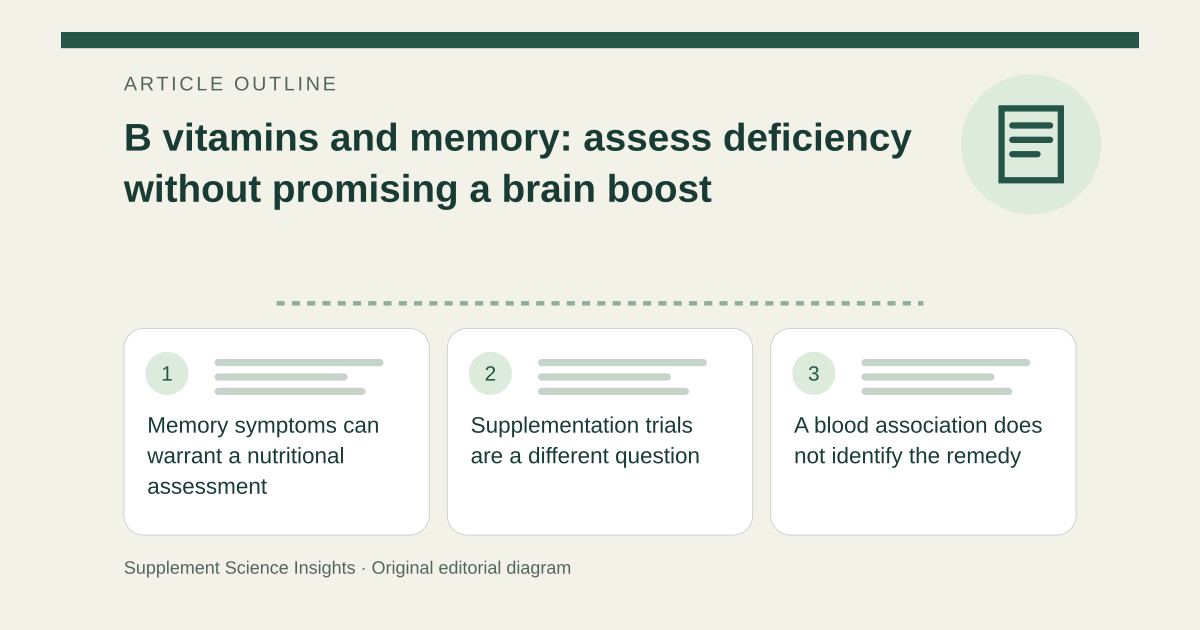
Memory symptoms can warrant a nutritional assessment
NICE includes difficulty concentrating and short-term memory problems among possible B12-deficiency features. It also cautions against ruling out deficiency solely because anemia is absent. Symptoms are not specific enough to diagnose the cause without considering other explanations and risk factors. [1]
Supplementation trials are a different question
ODS reports that B12, alone or with folate and B6, has not generally improved cognition in the trial populations it summarizes. Its B6 summary likewise describes insufficient evidence of benefit. These government summaries do not establish that every clinically deficient patient is unaffected by replacement. [2][3]
A blood association does not identify the remedy
Low vitamin status or high homocysteine may correlate with poorer cognitive outcomes. Such observations can reflect multiple influences and cannot by themselves show that a retail blend reverses the problem. Ingredient combinations, nutritional status and actual clinical endpoints matter. [2][3]
Investigate persistent changes rather than stacking products
NHS advises assessment of memory problems. Review diet, symptoms, medicines and functional changes with a clinician. High amounts of B6 are not a risk-free way to compensate for an uncertain diagnosis. [4][3]
Compare two different treatment purposes
Imagine one person has confirmed B12 deficiency and another has adequate levels but wants sharper recall. The first needs cause-appropriate replacement; that indication does not establish a memory-boosting dose for the second. [1][2]
| Situation | Relevant action |
|---|---|
| Deficiency suspected | Clinical assessment and appropriate tests |
| Deficiency confirmed | Cause-specific replacement |
| Adequate nutrition | Do not assume additional vitamins enhance memory |
Sources for this article
- Recommendations | Vitamin B12 deficiency in over 16s: diagnosis and management | Guidance | NICE
Source consulted: 2026-09-21. This is a reference resource, not a claim that we conducted the studies or tested a product. - Vitamin B12 - Health Professional Fact Sheet
Source consulted: 2026-09-21. This is a reference resource, not a claim that we conducted the studies or tested a product. - Vitamin B6 - Health Professional Fact Sheet
Source consulted: 2026-09-21. This is a reference resource, not a claim that we conducted the studies or tested a product. - Memory loss (amnesia) - NHS
Source consulted: 2026-09-21. This is a reference resource, not a claim that we conducted the studies or tested a product.