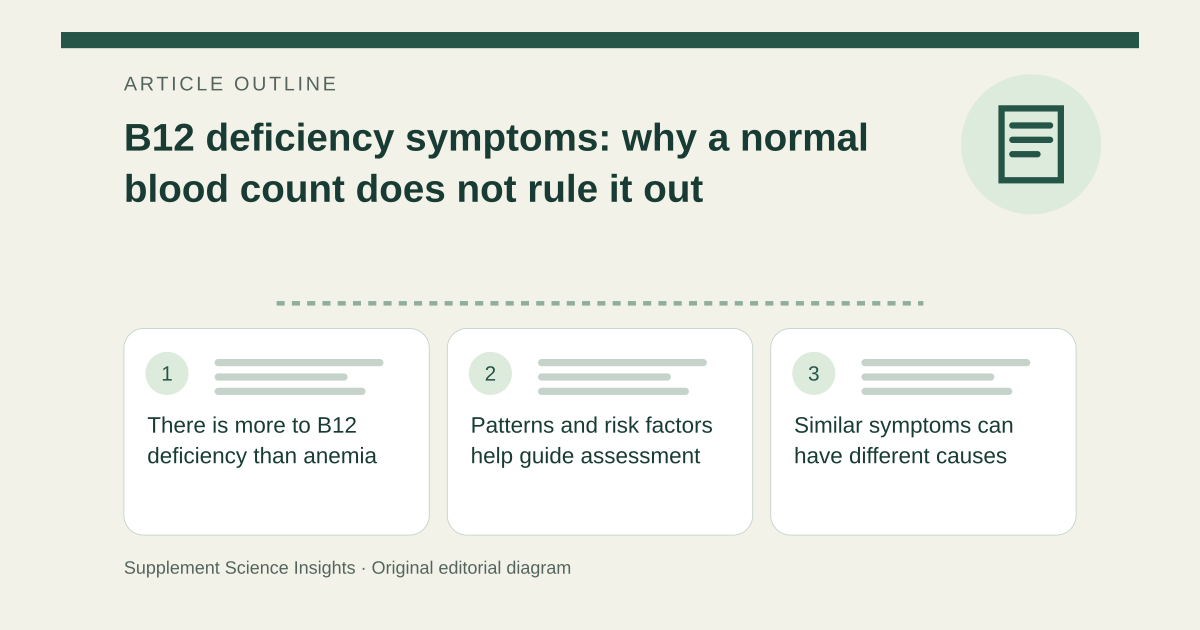
There is more to B12 deficiency than anemia
B12 deficiency can cause fatigue, tongue inflammation and changes in blood cells, but it can also affect the nervous system. Tingling, numbness, balance problems and difficulty concentrating can be part of the picture. These symptoms do not all occur together, and none is unique to B12 deficiency. [1][2]
NICE explicitly advises against ruling out deficiency just because anemia or enlarged red blood cells are absent. A normal blood count is useful information, but it is not a complete B12 assessment when the symptoms and risk history suggest another reason to investigate. [1][2]
Patterns and risk factors help guide assessment
Relevant risks include a diet with few B12 sources, certain gastrointestinal conditions or operations, metformin, acid-suppressing medicines and recreational nitrous oxide use. Tell the clinician about these exposures rather than trying to diagnose the cause from the symptom alone. [1]
For people over 16, NICE recommends testing when a common symptom or sign occurs with a common risk factor, and using clinical judgment when symptoms are present without a recognized risk factor. This is more informative than assuming that every episode of fatigue requires B12 or that a meat-containing diet excludes deficiency. [1]
Similar symptoms can have different causes
Fatigue, memory complaints and altered sensation occur in many conditions. B12 deficiency is one possible explanation, not a shortcut around examining other causes. A clinician may use an initial B12 test and, when needed, further testing such as MMA to clarify uncertain results. [2][1]
ODS notes that body stores can delay the appearance of deficiency symptoms for years. A recent dietary change or a few days of a supplement therefore cannot reliably establish when a deficiency began or whether it has been fully treated. [2][1]
A blood-count result does not erase the symptom history
Imagine a person reports persistent pins and needles and unsteadiness, but their blood count has no anemia flag. The appropriate record preserves both facts. It should not be shortened to “normal blood test, therefore no deficiency.” Nor should it be rewritten as a confirmed B12 diagnosis before assessment.
Bring the onset, progression and effect on daily activities, together with medicines, dietary restrictions and any B12 already used. This makes the consultation more useful than a symptom checklist with a self-selected diagnosis.
| Observation | Useful interpretation |
|---|---|
| Persistent tingling | Describe onset, distribution and progression |
| No anemia flag | Does not alone exclude B12 deficiency |
| B12 already taken | Tell the clinician before interpreting results |
Do not delay assessment of neurological symptoms
Early recognition matters because neurological injury from B12 deficiency can become irreversible. New or worsening balance, sensory or other neurological problems need timely medical assessment rather than a prolonged trial of a supplement bought online. [2][1]
NICE advises clinicians not to delay replacement while waiting for test results when megaloblastic anemia and neurological symptoms suggest B12 deficiency. It also advises taking diagnostic samples before replacement where feasible. Those decisions should be coordinated by the treating team; do not postpone urgent care in order to obtain an ideal test. [2][1]
Sources for this article
- NICE NG239 — Vitamin B12 deficiency in over 16s: recommendations
Source consulted: 2026-09-17. This is a reference resource, not a claim that we conducted the studies or tested a product. - NIH ODS — Vitamin B12: Health Professional Fact Sheet
Source consulted: 2026-09-17. This is a reference resource, not a claim that we conducted the studies or tested a product.