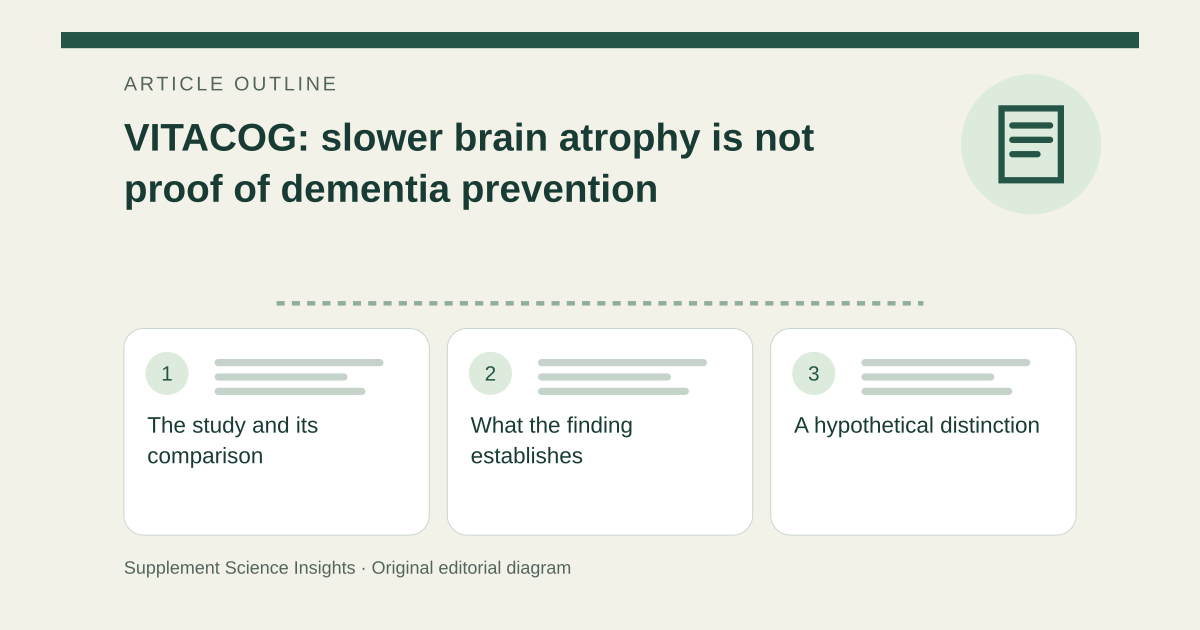
The study and its comparison
A randomized controlled trial enrolled 271 participants. Its population was adults over seventy with mild cognitive impairment; 168 completed mri follow-up. The comparison used folic acid 0.8 mg, b12 0.5 mg and b6 20 mg daily versus placebo, with observation over twenty-four months. [1]
Mean annual brain-volume loss was 0.76% with the vitamin combination and 1.08% with placebo in the MRI analysis. A larger response was reported in participants with higher baseline homocysteine. [1]
What the finding establishes
The imaging subset and subgroup comparison need separate interpretation. Brain-volume change is a surrogate, and the authors called for trials of dementia development. An author held relevant patent interests; tablet donation and past industry honoraria were disclosed. The combination cannot establish an isolated B12 effect. Complete funding and conflict details were not independently established. [1]
A hypothetical distinction
Imagine an MRI marker changes without a demonstrated reduction in dementia diagnoses. The marker result cannot substitute for that clinical endpoint.
| Detail | Interpretation |
|---|---|
| Measured outcome | Keep the endpoint specific |
| Study preparation | Not every retail product |
| Remaining uncertainty | Not resolved by a mechanism |
Sources for this article
- Homocysteine-lowering by B vitamins slows the rate of accelerated brain atrophy in mild cognitive impairment: a randomized controlled trial.
Source consulted: 2026-09-19. This is a reference resource, not a claim that we conducted the studies or tested a product.