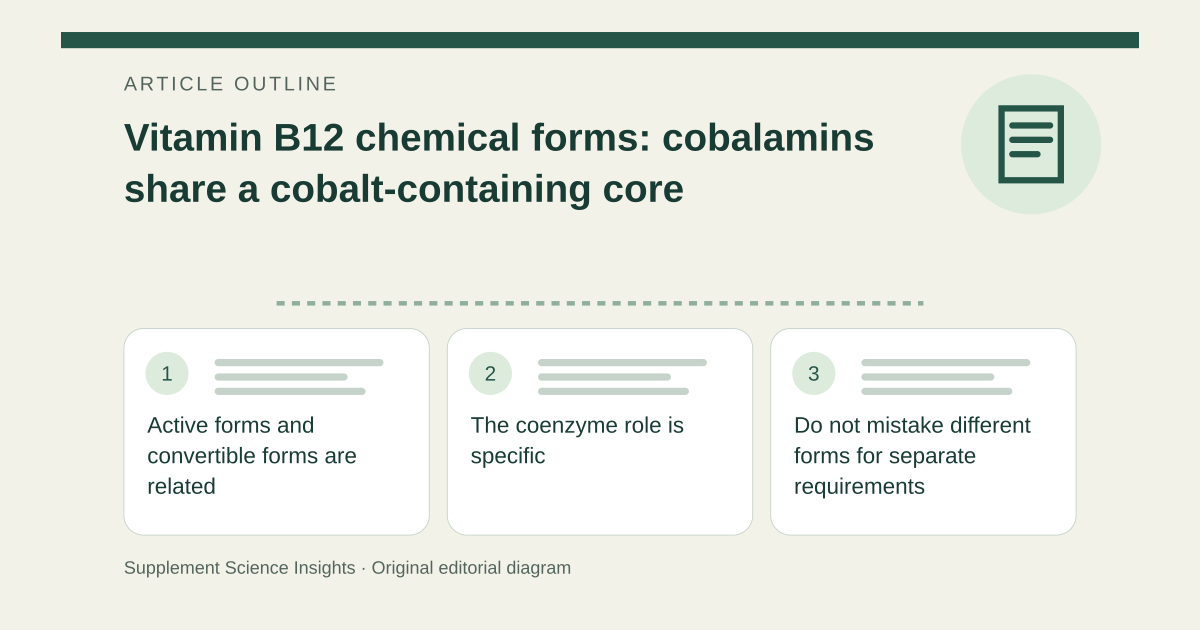
Active forms and convertible forms are related
Vitamin B12 has a cobalt atom held within a corrin ring. A lower ligand commonly contains 5,6-dimethylbenzimidazole, while the upper ligand differs between forms: cyano in cyanocobalamin, hydroxo in hydroxocobalamin, methyl in methylcobalamin and adenosyl in adenosylcobalamin. These names describe related cobalt-containing structures, not four unrelated vitamins. [1][2]
NIH ODS identifies methylcobalamin and 5-deoxyadenosylcobalamin as metabolically active forms. Hydroxocobalamin and cyanocobalamin become active after conversion to those forms. [1][2]
Thus, containing cyano or hydroxo in the name does not mean a preparation is biologically inactive. Conversion is part of how the body uses these forms. [1][2]
The coenzyme role is specific
B12 serves as a cofactor for methionine synthase and methylmalonyl-CoA mutase. These enzyme roles help explain its involvement in normal blood-cell, nervous-system and metabolic function. [1]
Chemical identity alone does not prove one retail product gives better clinical results. Route, amount, absorption problems and the reason for treatment still matter. [1]
Do not mistake different forms for separate requirements
Imagine someone takes two B12 forms because they believe each is a separate vitamin. Both contribute to B12 exposure; their names do not establish two independent daily requirements.
| Detail | Interpretation |
|---|---|
| Cobalamins | Related cobalt-containing compounds |
| Conversion | Can produce active forms |
| Clinical choice | More than the chemical name |
Sources for this article
- Vitamin B12 - Health Professional Fact Sheet
Source consulted: 2026-09-17. This is a reference resource, not a claim that we conducted the studies or tested a product. - Vitamin B12: biosynthesis and structural overview
Source consulted: 2026-09-20. This is a reference resource, not a claim that we conducted the studies or tested a product.