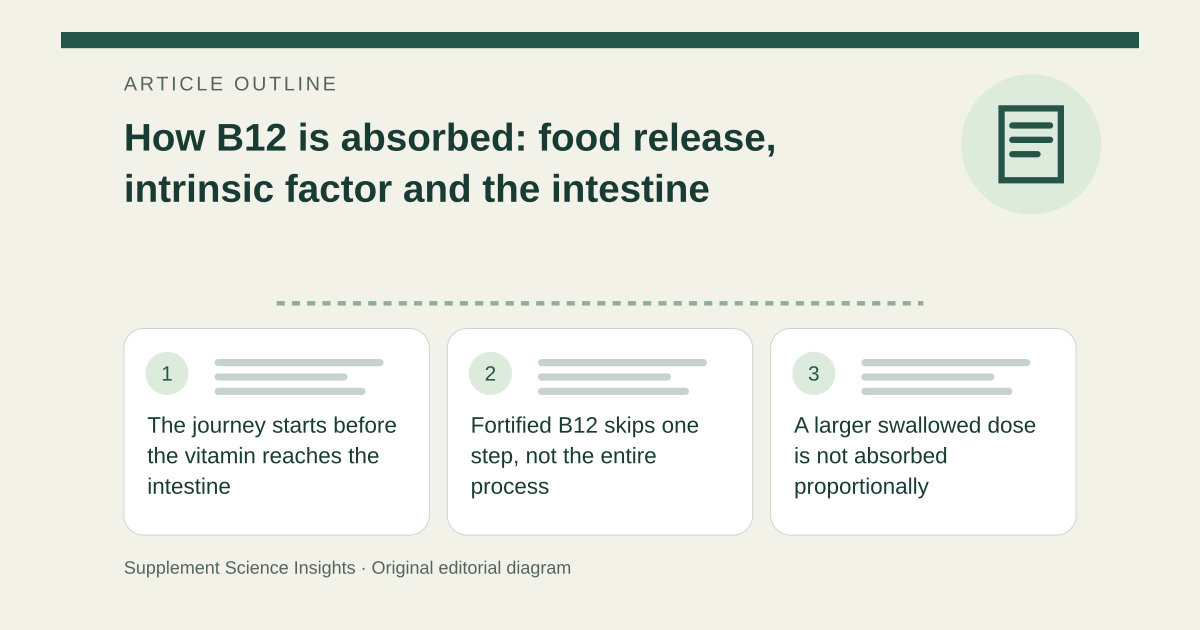
The journey starts before the vitamin reaches the intestine
After absorption, B12 participates in metabolism through active coenzyme forms. Methylcobalamin supports methionine synthase, which converts homocysteine to methionine; adenosylcobalamin supports methylmalonyl-CoA mutase, which converts methylmalonyl-CoA to succinyl-CoA. Cyanocobalamin and hydroxocobalamin must be converted into active forms. These cellular roles explain why absorption and biochemical use are related but distinct steps; they do not show that extra B12 improves metabolism in someone already adequately supplied. [1]
B12 in food is commonly attached to protein. Digestion releases it, and the vitamin binds to a carrier called haptocorrin. In the small intestine, digestive enzymes release B12 from that carrier so it can bind to intrinsic factor, a protein made by cells in the stomach. [1]
The B12–intrinsic-factor complex is then taken up in the distal ileum, near the end of the small intestine. This sequence explains why a nutrient present in the diet may still fail to reach the body in sufficient amounts. Intake and absorption are connected, but they are not the same measurement. [1]
Fortified B12 skips one step, not the entire process
B12 added to fortified foods and supplements is already in free form. It does not first need to be released from food protein. This can be useful when the problem is difficulty freeing food-bound B12, including some circumstances involving reduced stomach acid. [1]
It does not follow that every absorption problem disappears with an over-the-counter tablet. A loss of intrinsic-factor function, disease affecting the intestine or surgery that removes relevant tissue changes a different part of the pathway. Identifying the affected step helps explain why the same food advice does not fit every case. [1]
A larger swallowed dose is not absorbed proportionally
The intrinsic-factor-mediated pathway has limited capacity. ODS describes a much smaller percentage absorbed at high supplemental doses than at small amounts. Some high-dose oral treatment can nevertheless work in selected circumstances; a low percentage of a large dose may still deliver a meaningful quantity. [1][2]
That general explanation is not a way to calculate an individual’s absorbed dose. A percentage reported in a source is not a personal absorption test, and effectiveness depends on the cause of deficiency, treatment choice and follow-up. NICE distinguishes management for different forms of malabsorption. [1][2]
Locate the problem before comparing solutions
Imagine one person has difficulty releasing B12 from food, while another has had the terminal ileum removed. Both may have low B12, but the interruptions occur at different points. A product that avoids the food-release step cannot be assumed to replace a missing intestinal absorption site.
The useful question is not simply “Which B12 is strongest?” It is “What is limiting absorption, and what replacement route and monitoring does that cause require?” This hypothetical comparison explains the pathway without prescribing treatment.
| Affected step | What the distinction means |
|---|---|
| Release from food protein | Free B12 avoids the food-release step |
| Intrinsic-factor pathway | Dietary adequacy alone may not solve the problem |
| Terminal ileal uptake | Intestinal anatomy changes the treatment question |
Investigate the cause when deficiency is suspected
Gastrointestinal disease, surgery, autoimmune gastritis and certain medicines can affect B12 status. A history of these conditions belongs in the assessment even if the person eats animal foods or uses a supplement. Neurological symptoms can occur without anemia and should not be dismissed on that basis. [1][2]
The sources here are an NIH synthesis and a clinical guideline. The article explains physiology and management distinctions; it does not independently compare treatment trials or recommend changing a prescribed injection or oral regimen. [1][2]
Sources for this article
- NIH ODS — Vitamin B12: Health Professional Fact Sheet
Source consulted: 2026-09-17. This is a reference resource, not a claim that we conducted the studies or tested a product. - NICE NG239 — Vitamin B12 deficiency in over 16s: recommendations
Source consulted: 2026-09-17. This is a reference resource, not a claim that we conducted the studies or tested a product.