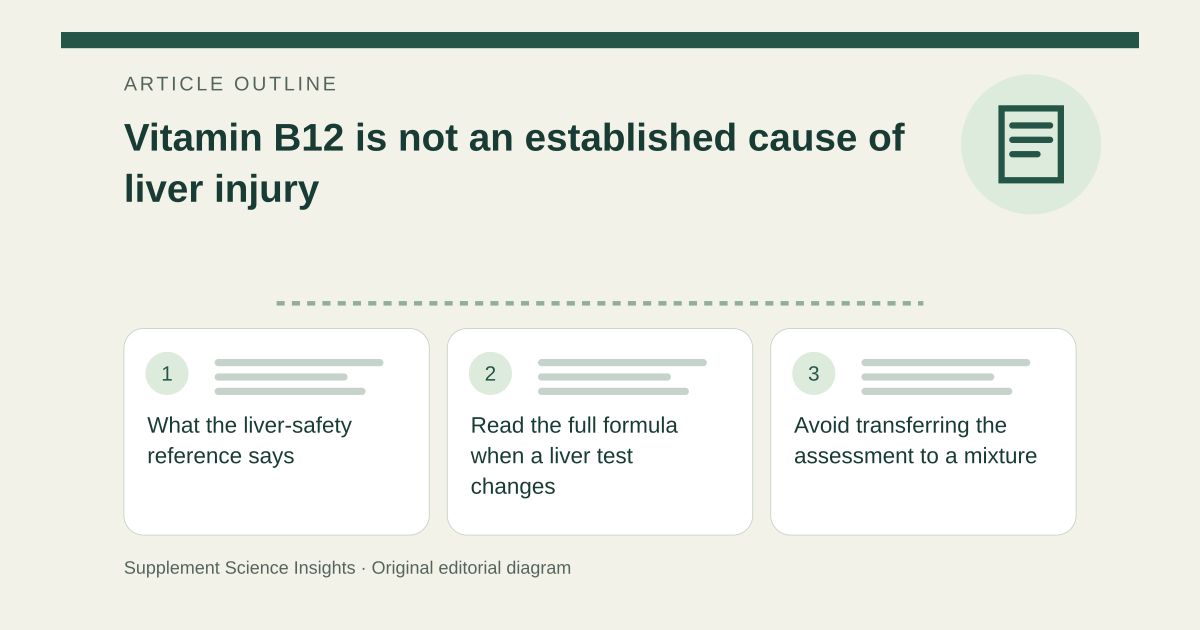
What the liver-safety reference says
LiverTox assigns vitamin B12 an unlikely likelihood of causing liver injury. Its assessment concerns the available evidence for B12, not a promise that symptoms or abnormal test results can be ignored. [1]
The same resource treats different B vitamins separately. A conclusion about B12 should not be extended automatically to niacin or to a product combining vitamins, herbs and other substances. [1]
Read the full formula when a liver test changes
If liver tests become abnormal while taking supplements, document all ingredients, doses and start dates for the healthcare professional assessing the change. Merely identifying B12 on one label does not establish causation. [1]
This reference also does not show that higher doses improve liver health. Evidence that an ingredient is unlikely to cause liver injury and evidence that it treats liver disease answer different questions. [1]
Avoid transferring the assessment to a mixture
Imagine a product contains B12 alongside several botanical extracts. The B12 liver-safety assessment cannot be used to declare the entire mixture free of liver risks.
| Detail | Interpretation |
|---|---|
| B12 hepatotoxicity assessment | Unlikely cause in LiverTox |
| Multi-ingredient product | Requires separate assessment |
| Liver treatment benefit | Not established by safety alone |
Sources for this article
- Vitamin B - LiverTox - NCBI Bookshelf
Source consulted: 2026-09-19. This is a reference resource, not a claim that we conducted the studies or tested a product.