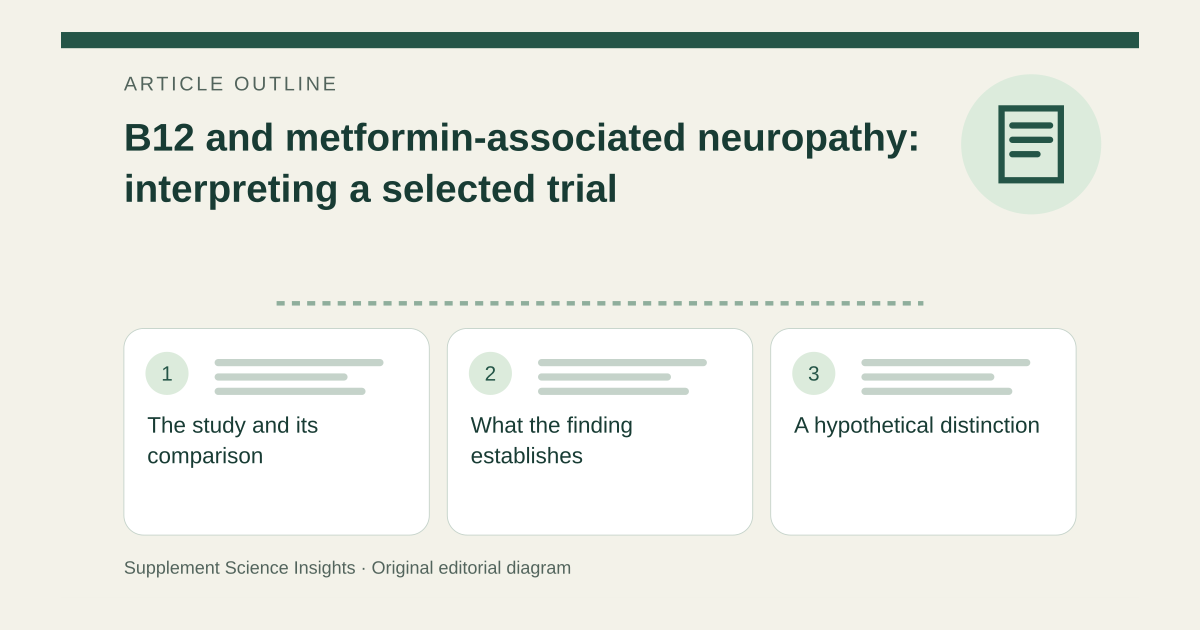
The study and its comparison
A randomized controlled trial enrolled 90 participants. Its population was adults with type 2 diabetes, neuropathy, metformin use for at least four years and b12 below 400 pmol/l. The comparison used methylcobalamin 1 mg daily versus placebo, with observation over twelve months. [1]
The report describes improvements in several nerve-conduction, sensory, pain and quality-of-life measures with B12. Cardiovascular autonomic reflex tests and the clinical examination score did not improve significantly. [1]
What the finding establishes
The abstract emphasizes changes within groups; those should not automatically be read as direct treatment-effect estimates. This selected population does not establish benefit for every person with diabetes or for glucose control. The supplier provided the supplement and reportedly had no study role; authors declared no conflict. Complete funding and conflict details were not independently established. [1]
A hypothetical distinction
Imagine a nerve-conduction measure changes but an autonomic test does not. Describing all nerve outcomes as improved would be inaccurate.
| Detail | Interpretation |
|---|---|
| Measured outcome | Keep the endpoint specific |
| Study preparation | Not every retail product |
| Remaining uncertainty | Not resolved by a mechanism |
Sources for this article
- Vitamin B12 Supplementation in Diabetic Neuropathy: A 1-Year, Randomized, Double-Blind, Placebo-Controlled Trial.
Source consulted: 2026-09-19. This is a reference resource, not a claim that we conducted the studies or tested a product.