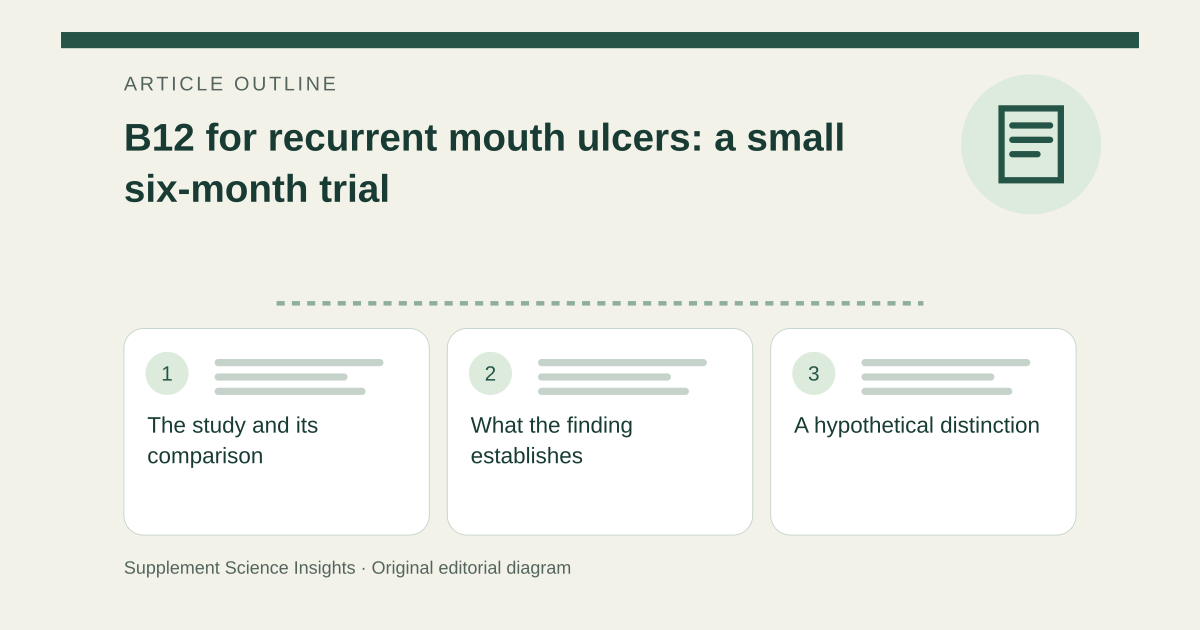
The study and its comparison
A randomized controlled trial enrolled 58 participants. Its population was primary-care patients with recurrent aphthous stomatitis. The comparison used sublingual b12 1000 micrograms daily versus placebo, with observation over six months. [1]
Outbreak duration, ulcer number and pain favored B12 at months five and six. In the last treatment month, 74.1% of assessed active-treatment participants versus 32.0% of controls were ulcer-free. [1]
What the finding establishes
The small trial reported benefit regardless of starting B12 levels, so its result cannot diagnose a deficiency from symptoms. The late assessment and selected recurrent-ulcer population limit generalization to other oral lesions. Larger replication would clarify durability. Funding and complete conflicts were not established from the retrieved abstract. [1]
A hypothetical distinction
Imagine symptoms improve after supplementation despite normal starting nutrient levels. Improvement alone does not prove the original symptom was a deficiency.
| Detail | Interpretation |
|---|---|
| Measured outcome | Keep the endpoint specific |
| Study preparation | Not every retail product |
| Remaining uncertainty | Not resolved by a mechanism |
Sources for this article
- Effectiveness of vitamin B12 in treating recurrent aphthous stomatitis: a randomized, double-blind, placebo-controlled trial.
Source consulted: 2026-09-19. This is a reference resource, not a claim that we conducted the studies or tested a product.