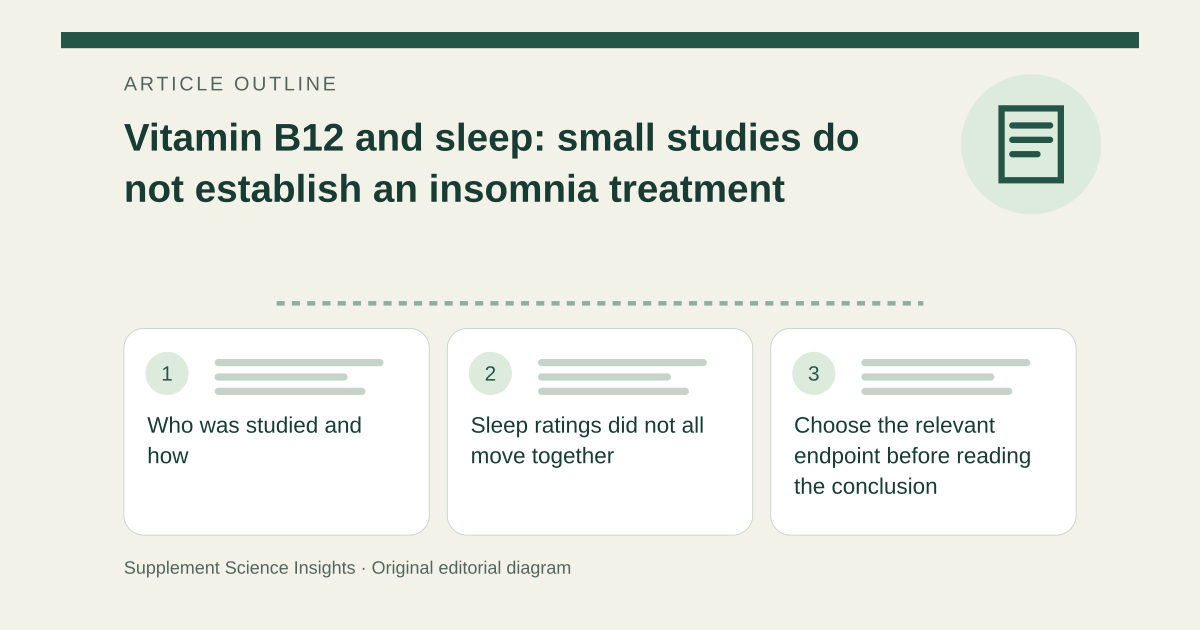
Who was studied and how
The study enrolled ten healthy male industrial shift workers, with a mean age of 35 years. Everyone first received placebo for two weeks and then methylcobalamin for three weeks in a single-blind, fixed-order design. [1]
That order matters: changes across periods could reflect time or other factors as well as the intervention. This was not a large randomized insomnia trial in a broad population. [1]
Sleep ratings did not all move together
The abstract reported no significant group difference in sleep-onset or wake-up ratings or subjective performance. It also reported better average subjective sleep quality during the B12 period and a tendency toward shorter total sleep time. [1]
Those mixed endpoints should not be compressed into either B12 cures insomnia or B12 inevitably prevents sleep. The population, design and short follow-up limit both conclusions. [1]
Choose the relevant endpoint before reading the conclusion
Imagine someone wants to sleep longer, while a study reports a better subjective quality score without longer sleep. The reported benefit does not directly answer that person’s duration question.
| Detail | Interpretation |
|---|---|
| Ten male shift workers | Narrow population |
| Fixed treatment order | Important design limitation |
| Mixed sleep endpoints | No general sleep prescription |
Sources for this article
- [Effect of vitamin B12 on sleep quality and performance of shift workers] - PubMed
Source consulted: 2026-09-19. This is a reference resource, not a claim that we conducted the studies or tested a product.