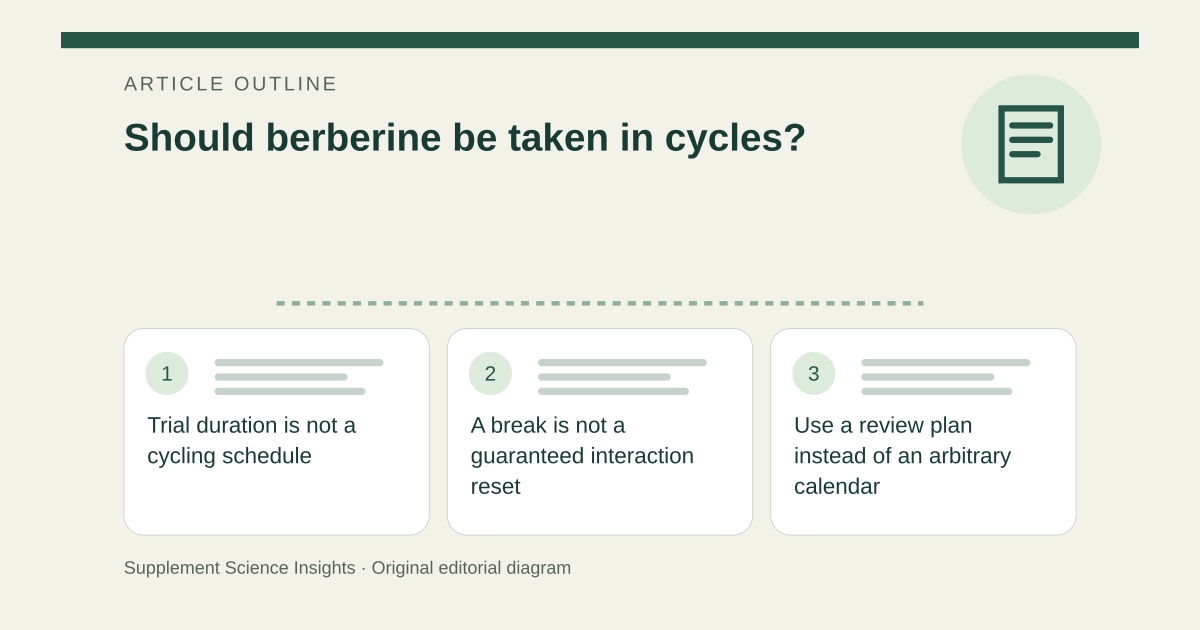
Trial duration is not a cycling schedule
A study that gives berberine for a set period does not show that participants then need a specific break. NCCIH notes substantial differences in formulations, populations and study quality. Those limitations prevent turning a trial endpoint into an optimized on-off regimen. [1]
A break is not a guaranteed interaction reset
A 2026 interaction review states that the duration of enzyme effects after stopping has not been quantified in humans. Laboratory mechanisms cannot supply a safe universal washout interval. Cycling therefore does not remove the need for medicine review. [2]
Use a review plan instead of an arbitrary calendar
If use is being supervised, agree on the reason, relevant outcome, adverse-effect monitoring and when to reconsider it. Do not repeatedly restart a product that causes concerning symptoms or adjust prescribed diabetes treatment to fit a supplement cycle. [1][2]
A repeated pattern is not proof of optimization
Imagine someone uses eight weeks on and two weeks off because an online post recommends it. Without a comparison of that schedule against alternatives, the calendar supplies no evidence of better results. The useful question is whether the product has a justified role at all. [1]
| Schedule claim | What is missing |
|---|---|
| Eight weeks in a trial | Proof of the ideal break |
| Cycling prevents tolerance | Validated human comparison |
| A break removes interactions | Measured human recovery time |
| Regular reassessment | A practical review, not a proven cycle |
Sources for this article
- Berberine and Weight Loss: What You Need To Know | NCCIH
Source consulted: 2026-09-21. This is a reference resource, not a claim that we conducted the studies or tested a product. - Berberine-Drug Interactions: Mechanisms, Clinical Relevance and Risk Stratification—A Narrative Review - PMC
Source consulted: 2026-09-21. This is a reference resource, not a claim that we conducted the studies or tested a product.