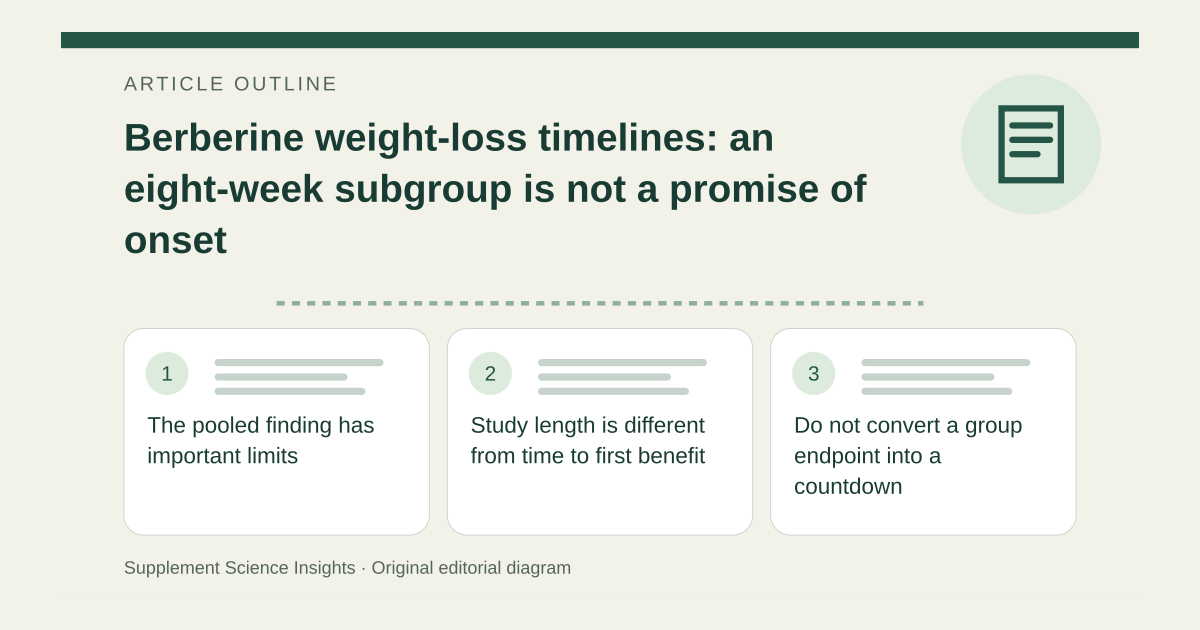
The pooled finding has important limits
NCCIH’s November 2023 summary describes a 2022 review of 18 studies assessing weight and 23 assessing body mass index. The review found decreases overall, but many studies had high risk of bias and individual findings were inconsistent. Participants often had diabetes or fatty-liver disease, and most research took place in Asian countries. [1]
Signals were more apparent in studies lasting over eight weeks and using certain higher amounts. That observation is not a validated minimum dose, a guaranteed response time or a recommendation to continue despite adverse effects. [1]
Study length is different from time to first benefit
A trial measured at twelve weeks does not establish the day on which any change began. Differences between longer and shorter studies may also involve populations, preparations or methods, rather than duration alone. [1]
NCCIH concludes that higher-quality research is needed before definite weight-loss conclusions. A personal timeline cannot be calculated from these heterogeneous studies. Digestive adverse effects and medicine interactions remain relevant even when benefit has not appeared. [1]
Do not convert a group endpoint into a countdown
Imagine one study reports mean weight at twelve weeks but has no weekly measurements. It cannot tell whether a particular person should notice a change by day ten. The endpoint schedule does not provide that resolution.
| Observation | What it establishes |
|---|---|
| Twelve-week endpoint | When the group was assessed |
| First day of benefit | Not identified by that endpoint |
| Guaranteed personal loss | Not established |
Sources for this article
- NCCIH: Berberine and Weight Loss
Source consulted: 2026-09-17. This is a reference resource, not a claim that we conducted the studies or tested a product.