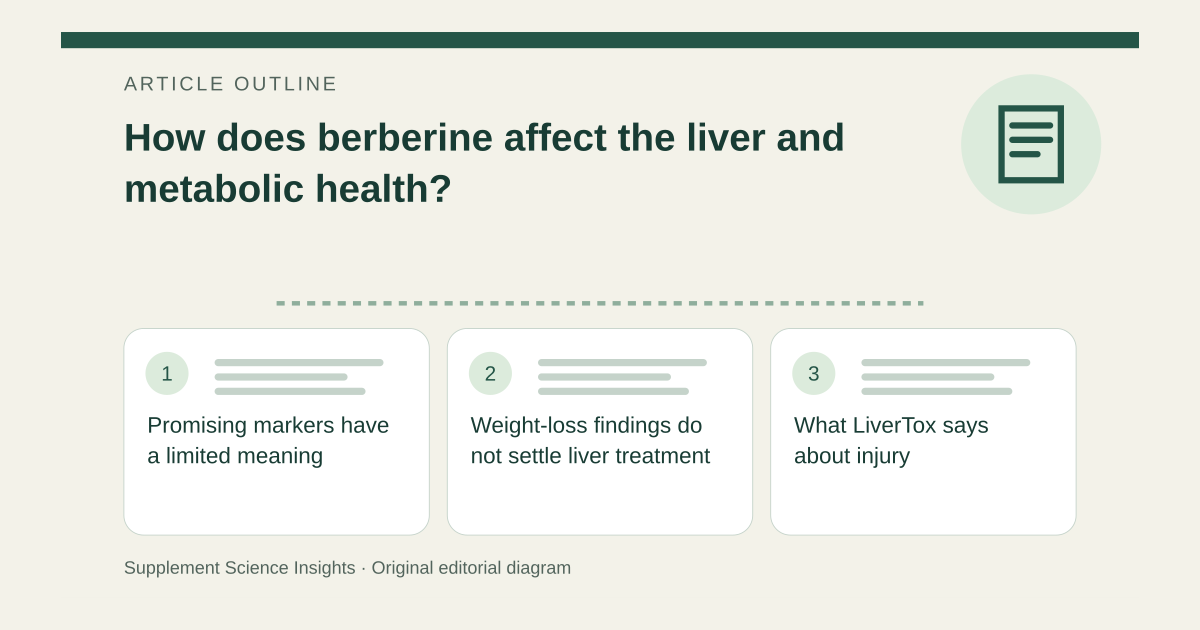
Promising markers have a limited meaning
MSK describes preliminary clinical findings in metabolic conditions, including fatty liver, while noting heterogeneous and often low-quality evidence. Improvements in glucose or lipid measurements do not establish that every berberine preparation reverses liver scarring or prevents cardiovascular events. [1]
Weight-loss findings do not settle liver treatment
NCCIH considers the weight-loss evidence inconclusive because of bias, inconsistent results and differing populations and formulations. Many participants already had diabetes or fatty liver. Results in those selected groups cannot establish a universal liver-health supplement for healthy adults. [2]
What LiverTox says about injury
The October 2020 LiverTox monograph reports no established association with serum enzyme elevations or clinically apparent liver injury and rates berberine an unlikely cause. It also notes that few prospective studies reported detailed laboratory safety findings. This is a dated evidence assessment, not a guarantee for every current product or combination. [3]
Formulation and medicines still matter
Herbal extracts, isolated berberine and multi-ingredient blends are not interchangeable exposures. Berberine can affect drug disposition, and some interactions have human evidence. Review the exact product and medicines with the clinician managing liver or metabolic disease instead of substituting a supplement for prescribed care. [4][1]
Track the actual clinical question
Imagine liver enzymes improve after changes in diet, activity, medicines and a supplement. That sequence cannot isolate berberine as the cause or prove fibrosis has resolved. Interpret the results alongside the diagnosis and ongoing clinical plan. [1][2]
| Observation | Limit |
|---|---|
| Lower glucose or lipids | Not proof of fewer liver complications |
| Improved liver enzymes | Not direct proof of resolved fibrosis |
| LiverTox unlikely rating | Dated assessment with limited detailed safety data |
| Different blend | Requires its own ingredient review |
Sources for this article
- Berberine | Memorial Sloan Kettering Cancer Center
Source consulted: 2026-09-21. This is a reference resource, not a claim that we conducted the studies or tested a product. - Berberine and Weight Loss: What You Need To Know | NCCIH
Source consulted: 2026-09-21. This is a reference resource, not a claim that we conducted the studies or tested a product. - Berberine - LiverTox - NCBI Bookshelf
Source consulted: 2026-09-21. This is a reference resource, not a claim that we conducted the studies or tested a product. - Berberine-Drug Interactions: Mechanisms, Clinical Relevance and Risk Stratification—A Narrative Review - PMC
Source consulted: 2026-09-21. This is a reference resource, not a claim that we conducted the studies or tested a product.