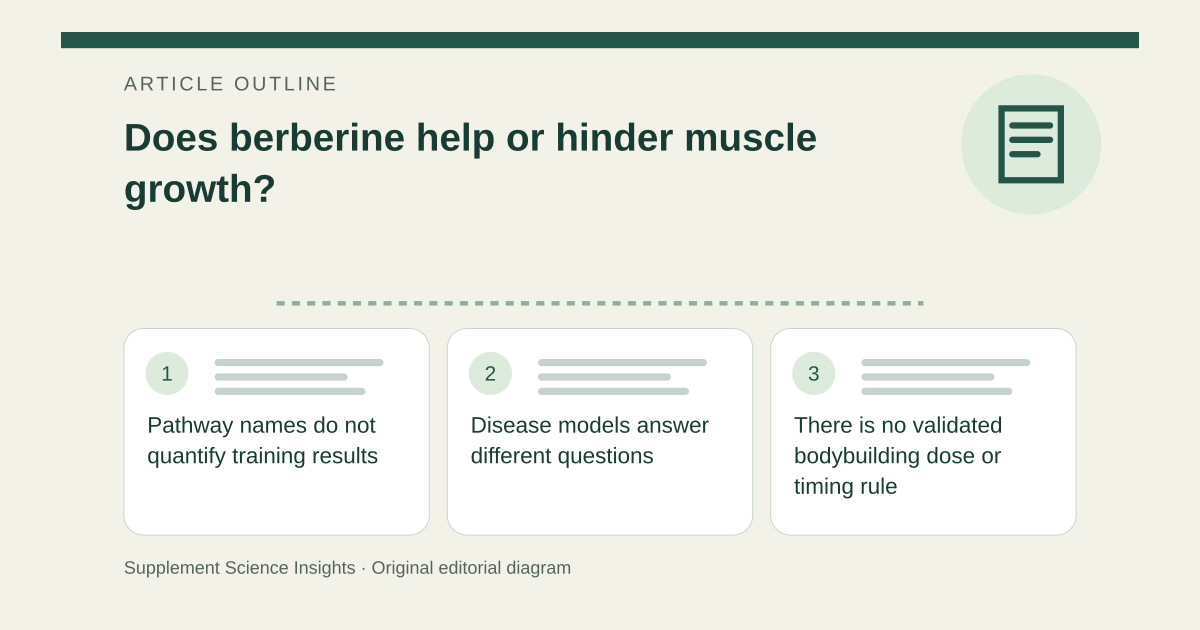
Pathway names do not quantify training results
Berberine research describes effects on several metabolic pathways, including AMPK. A musculoskeletal review emphasizes that many findings are from laboratory and animal work requiring human validation. A temporary pathway change does not tell us how much muscle a trained adult will gain over months. [1]
Disease models answer different questions
Protecting tissue in a disease model, changing insulin sensitivity or reducing body weight does not establish increased muscle size or strength during resistance training. Conversely, a mechanistic concern cannot prove that ordinary use inevitably blocks all gains. Direct, appropriately controlled training studies would be needed. [1][2]
There is no validated bodybuilding dose or timing rule
The sources reviewed here do not establish a dose for hypertrophy or a schedule that avoids a presumed AMPK–mTOR conflict. Berberine can cause digestive effects and interact with medicines, so taking it solely to improve nutrient partitioning adds uncertainty without demonstrated muscle benefit. [2][1]
Measure the outcome you care about
Imagine body weight falls while strength stays similar. That does not identify whether muscle, fat or fluid changed, or prove that a supplement improved muscle gain. Avoid interpreting a metabolic effect as a direct hypertrophy result. [2][1]
| Observation | Not established |
|---|---|
| AMPK-related mechanism | Size of a training effect |
| Better glucose marker | More muscle |
| Disease-model tissue effect | Healthy-lifter benefit |
| Weight loss | Improved hypertrophy |
Sources for this article
- Berberine and musculoskeletal disorders: The therapeutic potential and underlying molecular mechanisms.
Source consulted: 2026-09-21. This is a reference resource, not a claim that we conducted the studies or tested a product. - Berberine and Weight Loss: What You Need To Know | NCCIH
Source consulted: 2026-09-21. This is a reference resource, not a claim that we conducted the studies or tested a product.