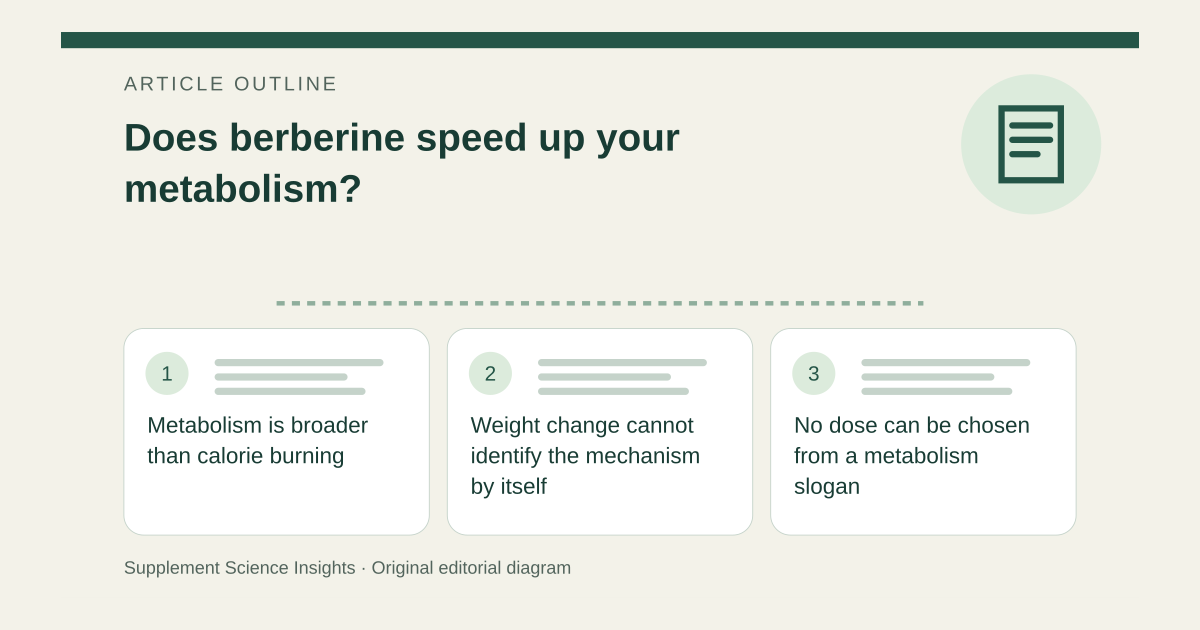
Metabolism is broader than calorie burning
Research discusses berberine effects on cellular energy sensing, glucose handling and other pathways. These mechanisms may help explain experimental observations, but activating an energy-related pathway does not directly measure a person’s resting metabolic rate or daily energy expenditure. [1]
Weight change cannot identify the mechanism by itself
NCCIH considers weight-loss evidence inconclusive because of inconsistent findings, bias and varied preparations. Even a real change in body weight does not by itself show that resting calorie expenditure increased; food intake and other factors may contribute. [2]
No dose can be chosen from a metabolism slogan
The inspected sources do not establish a universally effective dose for increasing human calorie burning. Digestive effects and medicine interactions remain relevant. More exposure or stronger absorption does not automatically produce a useful or safe metabolic effect. [2][1]
Choose the relevant outcome
Imagine someone has a lower fasting glucose reading after several lifestyle changes and berberine. That is not a measurement of extra calories burned. Define whether the goal is glucose control, weight management or another outcome and judge evidence for that specific question. [2][1]
| Finding | Not directly measured |
|---|---|
| Energy-sensing pathway activity | Daily calorie expenditure |
| Lower fasting glucose | Higher resting metabolic rate |
| Weight change | Its unique mechanism |
| Enhanced absorption | Guaranteed fat burning |
Sources for this article
- Berberine-Drug Interactions: Mechanisms, Clinical Relevance and Risk Stratification—A Narrative Review - PMC
Source consulted: 2026-09-21. This is a reference resource, not a claim that we conducted the studies or tested a product. - Berberine and Weight Loss: What You Need To Know | NCCIH
Source consulted: 2026-09-21. This is a reference resource, not a claim that we conducted the studies or tested a product.